Mayor Lucass Backs Another Taxpayer Grocery Gamble at Failed Linwood Site
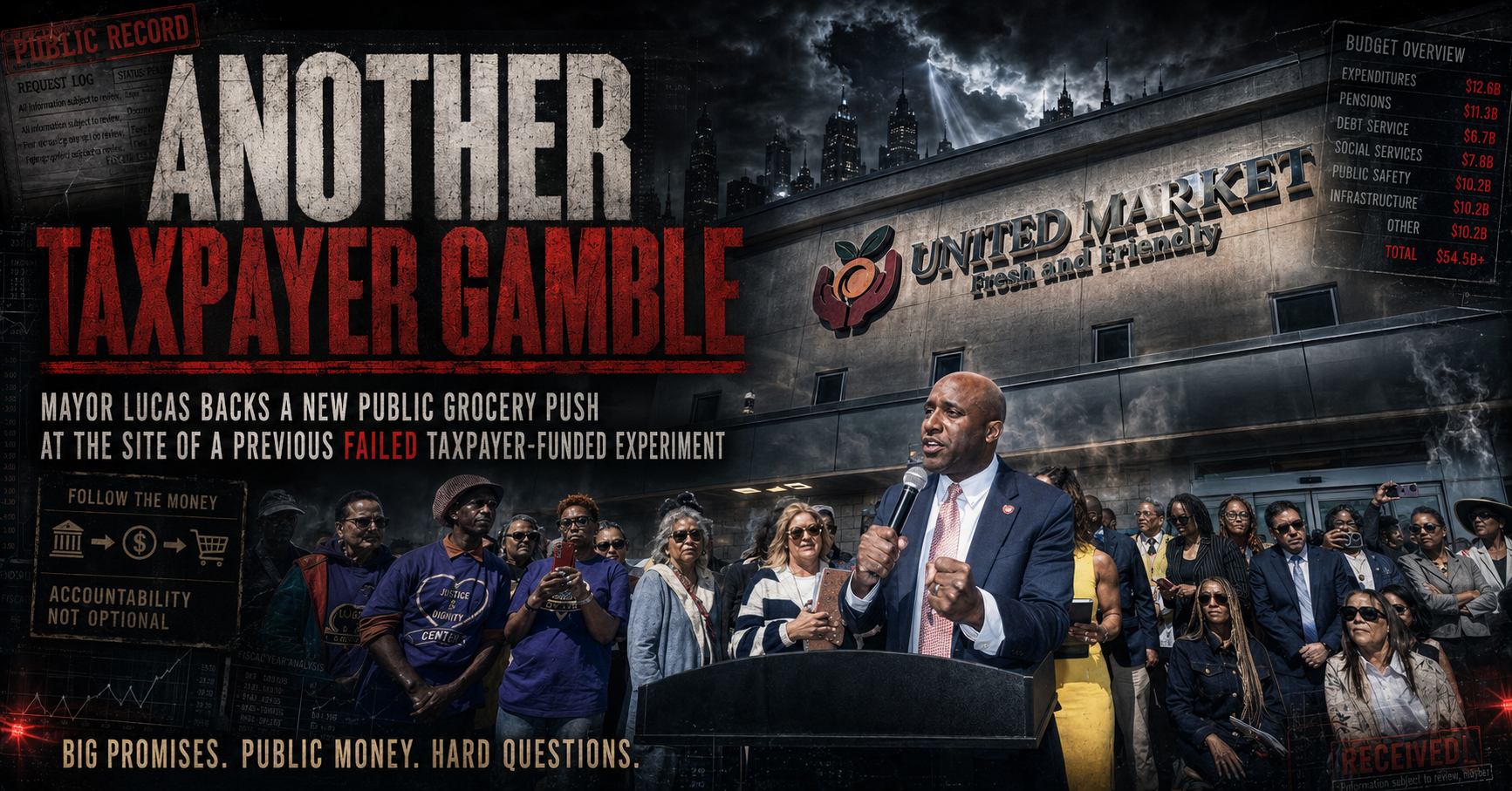
How Long Before United Market KC Becomes Another Mayor Quinton Lucass Failure?
How long will it take before United Market KC becomes another Mayor Quinton Lucas failure?
That is the question Kansas City taxpayers should be asking right now. Not because anyone should want a grocery store on the east side to fail, but because City Hall is once again putting public money, political promises, and a mayoral ribbon cutting into the same city-owned grocery site where the last taxpayer-backed grocery effort already collapsed.
Mayor Lucas wants the public to see a grand opening.
Taxpayers should be looking at the receipts.
This is not about whether the east side deserves a grocery store. It absolutely does. Every Kansas City neighborhood deserves access to fresh food, safe shopping, and basic services. The issue is whether City Hall has actually fixed the problems that helped sink the last grocery operation at 31st and Prospect, or whether this is another expensive political photo op wrapped in good intentions.
The store is located at 3110 Prospect Avenue inside the city-owned Linwood Shopping Center. That matters because this is not a normal private grocery store opening where a business owner takes the risk and taxpayers simply hope it works. This is a publicly backed project at a public property with public money already tied deeply into the site.
Kansas City already invested heavily in this location. The previous grocery operation, Sun Fresh, was supposed to be part of a major east side revitalization effort. Instead, Sun Fresh closed on August 12, 2025, after months of problems that included empty shelves, safety concerns, declining customer traffic, and financial distress.
That was not some ancient failure from decades ago. That was last year.
KCUR reported that Kansas City spent nearly $18 million revitalizing the grocery store and shopping center. The city’s own ordinance history also says Kansas City invested more than $15 million to acquire, construct, and equip the Linwood Shopping Center, including the grocery space.
Then the grocery store closed.
Then came the lawsuit.
Community Builders of Kansas City and Midtown Grocers sued the City of Kansas City in Jackson County Circuit Court. Their lawsuit alleges the city failed to properly address crime, property maintenance, and other conditions connected to the site. The city denies those claims and says it will defend itself. Those allegations still have to be proven in court.
But one fact does not need a courtroom to prove it: the prior taxpayer-backed grocery effort at this same location failed, the store closed, and the neighborhood was left without the full-service grocery option City Hall had promised.
Now Mayor Quinton Lucas is backing the next version.
Ordinance 260069 was sponsored by Mayor Quinton Lucas, along with Councilmembers Melissa Robinson and Melissa Patterson Hazley. The ordinance authorized Kansas City to execute a 10-year lease with United Market KC, LLC, with two additional five-year renewal options. That means this deal could connect the city to this operator and this model for up to 20 years.
The public money did not stop with the old Sun Fresh project.
The ordinance moved $750,905.40 from the Development Services Fund, $347,191.30 from the Linwood STIF Fund, and $401,903.30 from the Shared Success Fund into a Linwood United Market KC account. Together, that equals $1.5 million in new public support for the United Market KC project. The ordinance also authorized another $150,000 from previously appropriated Linwood Property Management funds.
That is not just encouragement.
That is taxpayer-backed startup support.
And the city’s own paperwork makes the situation look even worse.
The city docket memo for Ordinance 260069 said the legislation was not included in the adopted budget. It listed the funding source as “Unknown.” It said the program would require $1.5 million from a source “to yet be determined.” The staff recommendation was marked “Do Not Recommend,” with the explanation that passage should not be recommended until a viable funding source was determined.
Read that again.
City staff documented that the funding source was unknown. The money was not in the adopted budget. The memo said the ordinance should not move forward until a viable funding source was determined.
And Mayor Lucas still sponsored it.
That is the part taxpayers should not ignore.
This is exactly how Kansas City keeps getting into trouble. City Hall makes a big announcement, ties the project to a feel-good cause, rolls out the cameras, and then asks taxpayers to trust the same political leadership that failed to protect the last investment.
The lease terms also raise serious questions.
The lease form shows United Market KC paying base rent of only $1 per lease year for the first five years. The operator may pay up to $15,400 per month only if monthly sales hit $1,120,000 for three consecutive months. Years six through ten call for base rent of $15,833.33 per month.
The lease also includes a $1.5 million landlord contribution and city-funded security support through the Linwood CID for FY 2026-2027. It gives the tenant a purchase option after the initial 10-year term and a right of first refusal if the city receives a third-party offer to buy the property.
So taxpayers helped build the asset. Taxpayers watched the previous grocery operation collapse. Taxpayers are now watching City Hall approve another public support package. And the new operator gets a deeply favorable rent structure at the same city-owned location.
Supporters will say this is necessary because the neighborhood needs a grocery store.
That is the strongest argument for the project.
It is also the same argument City Hall uses every time the numbers stop making sense.
The east side does need grocery access. That is not in dispute. But public need does not excuse weak oversight. It does not excuse unclear funding. It does not excuse repeating a failed model without showing exactly what changed. And it does not excuse Mayor Lucas turning another taxpayer-backed risk into a ribbon-cutting victory lap before the hard questions are answered.
The prior store did not fail because the neighborhood did not need groceries.
It failed while the need was real.
It failed while public money had already been spent.
It failed while the city owned the property.
It failed while the location was supposed to be a symbol of revitalization.
That is why this new deal deserves aggressive public scrutiny.
Maybe United Market KC will do better. Maybe the new operator will keep the shelves full, maintain customer trust, control costs, improve security, and make the store sustainable. Everyone should hope that happens because the neighborhood deserves a real grocery option.
But hope is not a financial plan.
A ribbon cutting is not proof of success.
A mayor standing at a podium does not erase the public record.
The public record shows that Kansas City already poured millions into this location. The public record shows the previous grocery store closed. The public record shows litigation followed. The public record shows the new ordinance authorized $1.5 million in support, plus another $150,000. The public record shows the original docket memo said the funding source was unknown and staff did not recommend passage until a viable funding source was determined.
Those facts should bother every taxpayer in Kansas City.
This is not about attacking a grocery store. This is about demanding accountability from the elected officials who keep spending public money while avoiding responsibility when the promises do not hold.
Mayor Lucas has become very good at showing up for announcements. Kansas City needs leadership that is just as serious about results.
Before anyone calls United Market KC a success story, taxpayers deserve clear answers.
How much total public money has Kansas City spent at the Linwood Shopping Center from acquisition to reopening?
What exact public funds are being used to support United Market KC?
What safeguards protect taxpayers if this store fails like the last one?
What performance benchmarks does the operator have to meet?
What happens if sales never reach the threshold needed to trigger higher rent?
How much security will the public continue funding after the first year?
What did City Hall actually change to make sure this does not become Sun Fresh 2.0?
And why did Mayor Lucas sponsor a deal when the city’s own memo originally said the funding source was unknown and staff did not recommend passage until a viable source was determined?
Those are not cheap political shots.
Those are basic taxpayer questions.
Kansas City has seen this pattern too many times under Mayor Quinton Lucass. Big promise. Big photo op. Big public cost. Then when the project struggles, nobody at City Hall wants to own the failure.
United Market KC may succeed. For the sake of the neighborhood, it should succeed. But taxpayers should not be told to clap just because another sign went up on the building.
The question is not whether Kansas City needs grocery access.
The question is whether Mayor Lucas and City Hall have finally learned from the last failure, or whether taxpayers are being pulled into another expensive experiment at the exact same site.
Right now, based on the public record, this looks less like accountability and more like another taxpayer gamble.
And if it fails, nobody at City Hall should be allowed to act surprised.