Kansas City Crime Crisis: Mayor Lucas and the Missing Receipts
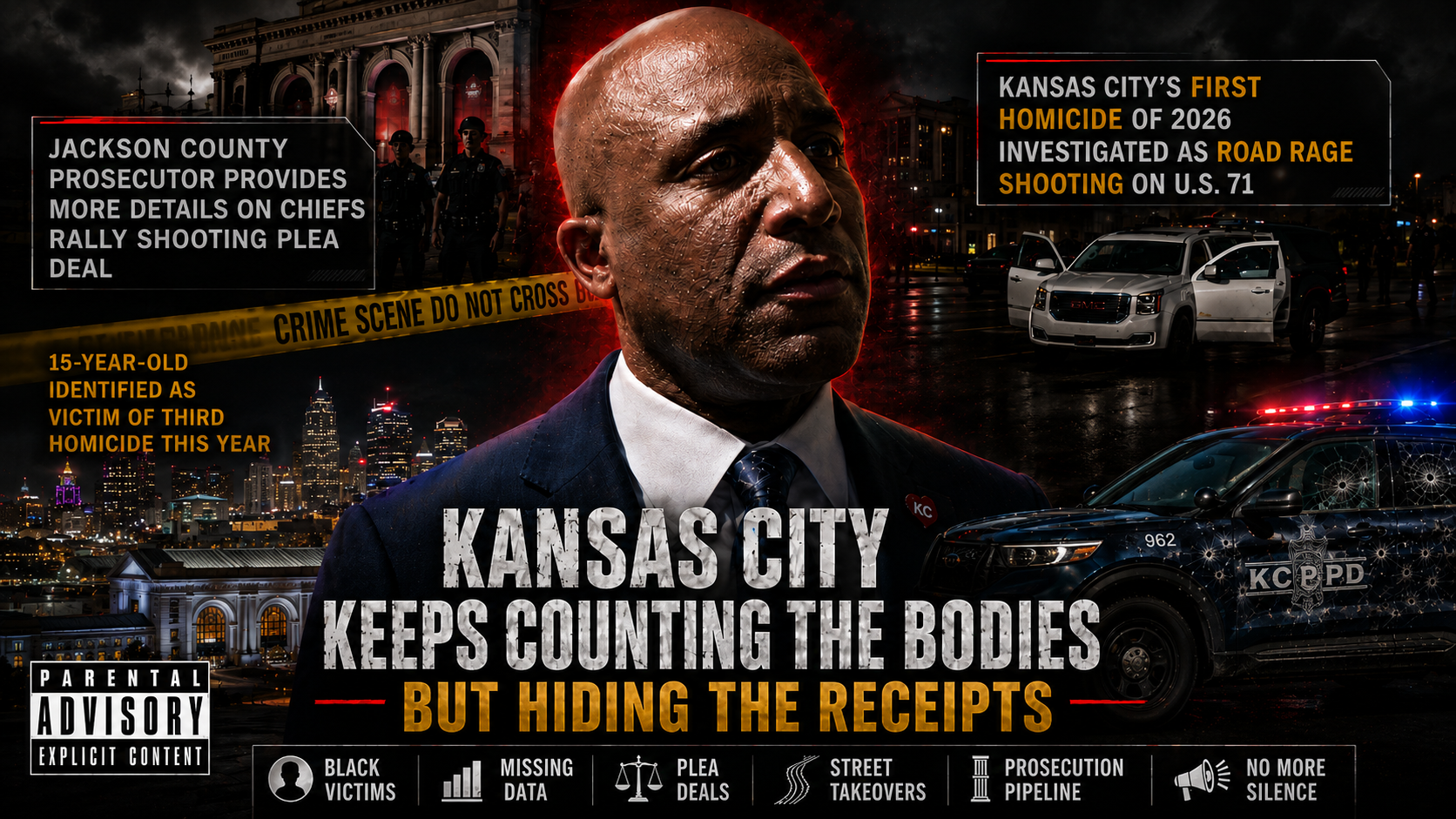
Kansas City Needs a Real Leader — Not Another Camera-Ready Excuse
Kansas City does not have a mystery violence problem.
It has a leadership problem.
It has a truth problem.
It has a public-safety system that keeps asking residents to trust the process while refusing to show the full receipts.
And at the top of City Hall sits Mayor Quinton Lucas.
Mayor Lucas is not personally pulling triggers in Kansas City. He is not the only person responsible for violence, prosecution failures, police policy, court decisions, street takeovers, repeat offenders, or the culture of lawlessness that too many residents are forced to live around.
But he is the mayor.
He is the public face of Kansas City.
He sits on the Kansas City Board of Police Commissioners. He has a national profile. He shows up for cameras. He speaks on criminal justice and gun violence. He is in the room when public-safety priorities are discussed. He has the platform, the title, the visibility, and the responsibility.
So he does not get to stand at the front of the cameras and then hide at the back of the accountability line.
Kansas City does not need another photo-op mayor.
Kansas City does not need another polished quote.
Kansas City does not need another national talking point.
Kansas City does not need another leader who sounds good on television while residents are still dodging bullets, watching street takeovers, burying children, and wondering why violent offenders keep moving through the system like consequences are optional.
Kansas City needs a true leader.
A leader who understands the streets.
A leader who understands that public safety is not a press release.
A leader who understands that residents do not care how good a mayor looks on the news if they cannot feel safe going to the store, driving on the highway, sitting in their car, attending a parade, standing outside a business, or raising children in their own neighborhood.
Mayor Lucas can point to programs.
City Hall can point to budgets.
The political class can point to committees, grants, public statements, “root causes,” “equity,” “violence prevention,” and “community safety.”
Fine.
But Kansas City residents are not asking for better language.
They are asking for safety.
They are asking for consequences.
They are asking for transparency.
They are asking for leadership.
And right now, the receipts are ugly.
Kansas City recorded 138 homicides in 2018. It recorded 138 homicides again in 2025. In between, the city hit a brutal peak of 182 homicides in 2023. Yes, homicides fell from that peak. Yes, robbery declined. Yes, KCPD reported a strong homicide clearance rate in 2025.
But do not let City Hall hide behind the word “progress.”
Progress does not erase the bodies.
Progress does not bring back the dead.
Progress does not excuse years of failure.
And progress does not change the fact that Kansas City ended 2025 with the same homicide count it had in 2018, after a deadly spike that happened under Mayor Lucas’s tenure. [3]
That is not victory.
That is survival being sold as leadership.
## Public Visibility Is Not Street-Level Leadership
Mayor Lucas has built a public profile. His official city biography describes him as Kansas City’s mayor and notes his national criminal-justice and gun-violence work. [1]
Fine.
But the people living with the consequences of Kansas City violence deserve to ask a simple question:
If the mayor is such a public voice on criminal justice and gun violence, why does Kansas City still feel like this?
Why did Kansas City hit 182 homicides in 2023?
Why are Black residents still being killed at wildly disproportionate levels?
Why are families still watching street takeovers, stolen cars, gun violence, police chases, weak consequences, and courthouse confusion play out over and over?
Why does the public still not have violent-felony conviction data by race for Jackson County?
Why does Kansas City still not have a full public prosecution dashboard that shows the pipeline from police referral to charge, plea deal, dismissal, conviction, sentence, and repeat-offender status?
Why does Kansas City keep getting speeches instead of receipts?
A mayor cannot control every criminal.
A mayor cannot prevent every shooting.
A mayor cannot personally prosecute every case.
A mayor cannot patrol every block.
But a mayor can set the tone.
A mayor can demand transparency.
A mayor can publicly pressure every agency in the system.
A mayor can stop hiding behind process.
A mayor can stop acting like national visibility equals local leadership.
A mayor can say plainly: Kansas City is dangerous, too many people are dying, and the current system is not good enough.
That is what leadership sounds like.
Not excuses.
## Do Not Let City Hall Hide Behind State Control Of KCPD
One of the favorite excuses in Kansas City politics is that KCPD is state-controlled.
That is partly true.
The Kansas City Board of Police Commissioners is responsible for providing police service to Kansas City residents. Four commissioners are appointed by the Missouri governor with the consent of the state Senate. The fifth member is the mayor of Kansas City. [2]
So no, Mayor Lucas is not the sole boss of KCPD.
But he is not a powerless spectator either.
He sits on the board.
He is the city’s chief elected official.
He helps shape the budget.
He shapes the public conversation.
He has access to media.
He has a platform.
He has political influence.
He can demand answers from police, prosecutors, courts, city departments, state leaders, and community organizations.
So stop pretending the mayor is just a bystander.
If he wants credit when crime goes down, he has to accept accountability when the city becomes dangerous.
That is how leadership works.
## The Body Count Is Not A Talking Point
The data does not need dramatic language.
The data is dramatic by itself.
Kansas City homicides rose from 138 in 2018 to 182 in 2023. They fell to 144 in 2024 and 138 in 2025. KCPD reported a 75% homicide clearance rate in 2025, above the national average cited by the department. Robbery fell from 1,564 in 2018 to 1,006 in 2025. [3]
Those numbers show two things at the same time.
First, KCPD and law enforcement deserve credit where the data shows improvement.
Second, Kansas City’s leadership class does not get to pretend the crisis is over.
A city with 138 homicides is still a dangerous city.
A city that merely returns to the 2018 homicide count after peaking in 2023 has not solved the problem.
A city where aggravated assault remains a massive violent-crime category has not solved the problem.
A city where residents keep seeing street takeovers, shootings, stolen cars, and repeat-offender questions has not solved the problem.
A city where families still worry about whether their children will make it home has not solved the problem.
Kansas City does not need leaders who celebrate a smaller body count like it is victory.
Kansas City needs leaders who understand that every number in that homicide table was a human being.
## Black Kansas Citians Are Paying The Highest Price
Here is the fact Kansas City leaders keep talking around:
Black residents are being killed at wildly disproportionate levels.
From 2018 through 2025, Black residents accounted for roughly 68% to 78% of KCPD homicide victims every year. In 2025, Black residents were 100 of Kansas City’s 138 homicide victims. Black residents are roughly 27% to 28% of the city’s population. [3]
That is not a rumor.
That is not social media.
That is not politics.
That is the homicide table.
Black Kansas Citians are not just “impacted” by violence.
They are being buried by it.
And what has Kansas City gotten from too many leaders?
Careful language.
Soft statements.
Community slogans.
Political fear.
Excuses dressed up as compassion.
But silence is not compassion.
Silence is abandonment.
If Black residents are roughly 28% of the city and roughly seven out of ten homicide victims year after year, then every leader in Kansas City should be forced to answer one question:
What exactly are you doing that is working?
Not what are you funding.
Not what are you announcing.
Not what committee are you forming.
What is working?
Because if the bodies keep stacking up, the answer is not enough.
## This Is Not Racism. This Is Refusing To Ignore The Dead.
Let’s be clear.
This is not about blaming Black people as a race.
That is lazy.
That is wrong.
That is not what the data proves.
The problem is violent street culture.
The problem is repeat offenders.
The problem is gun violence.
The problem is criminal status culture.
The problem is stolen cars.
The problem is street takeovers.
The problem is social-media glorification of crime.
The problem is weak consequences.
The problem is a prosecution pipeline the public cannot fully see.
The problem is political cowardice.
The problem is leaders who care more about managing language than managing violence.
And the people paying the highest price are Black residents themselves.
That is why this conversation matters.
It is not racist to say Black victims matter when Black victims are the ones filling the homicide table.
It is not racist to demand stronger consequences for repeat violent offenders.
It is not racist to demand better policing, better prosecution, better courts, better data, and better leadership.
What is wrong is pretending this subject is too sensitive to discuss while mothers are burying sons.
The math is not racist.
The silence is.
## The Suspect Data Is Uncomfortable — But It Must Be Used Honestly
KCPD’s homicide-victim data is the strongest race-based data because victims are identified through official investigations and medical-examiner records.
Suspect data is more limited.
A suspect is not a convicted offender.
A suspect is not proof of guilt.
Some homicide cases have multiple suspects.
Some suspects are later cleared.
Some suspect-race entries are unknown.
That distinction matters.
But serious people should not pretend the suspect data says nothing.
In the available KCPD homicide-suspect tables, Black suspects are the largest identified category in multiple years. In 2025, KCPD’s table listed 73 Black male suspects and 6 Black female suspects, with 33 listed as Other/Unknown. In 2024, the table listed 93 Black male suspects and 10 Black female suspects, with 31 listed as Other/Unknown. [3]
Again: suspect data is not conviction data.
But it is not meaningless either.
It is enough to demand a real public conversation.
Not race-baiting.
Not denial.
A real conversation.
Kansas City does not need people screaming “racism” every time a hard fact is spoken.
And it does not need people using crime data to smear an entire race.
It needs adults.
It needs precision.
It needs honesty.
## The Biggest Scandal Is The Data They Still Do Not Publish
Here is where the story becomes bigger than one mayor.
The public can see homicide-victim race.
The public can see some homicide-suspect race.
The public can see broad crime totals.
The public can see prosecutor press releases.
The public can see court totals for felony filings, dispositions, trials, and sentencing categories.
But the public still cannot see the central dataset needed to answer the hardest question:
Who is actually being convicted of violent felonies in Jackson County, broken down by race, offense, year, disposition, plea deal, sentence recommendation, and final sentence?
A primary-source research review covering 2018 through Q1 2026 found that no public source cross-tabulates Jackson County violent felony convictions by race of the convicted person. Not the Jackson County Prosecuting Attorney’s Office. Not the 16th Judicial Circuit. Not the Missouri Department of Corrections. [4]
That is not a small missing detail.
That is the whole ballgame.
Kansas City is arguing about race, crime, policing, prosecution, judges, jail, bond, diversion, and sentencing without the government publishing the very data needed to test the claims.
That helps nobody except public officials who do not want accountability.
If the data proves the system is fair, publish it.
If the data proves the system is failing, publish it.
If the data proves the truth is complicated, publish it.
But stop asking the public to trust a system that will not show the receipts.
## Arrests Are Not Consequences
Kansas City residents need to understand the pipeline.
Police can arrest someone.
That does not mean charges are filed.
Police can refer a case.
That does not mean it gets prosecuted.
The prosecutor can file charges.
That does not mean there is a conviction.
A person can be convicted.
That does not mean prison time.
A sentence can be imposed.
That does not mean the public understands how that sentence was reached.
This matters because politicians keep collapsing the entire criminal-justice system into one word:
“Crime.”
That is too simple.
Kansas City’s problem is not only what happens on the street.
It is also what happens after the arrest.
After the referral.
After the filing decision.
After the plea negotiation.
After the dismissal.
After the bond hearing.
After sentencing.
After probation.
After parole.
After the repeat offender gets another chance and somebody else gets buried.
The 16th Circuit’s public statistics show that in 2024 Jackson County had 6,332 felony filings, 3,038 felony dispositions, 25 jury trials, and 3 court trials. That is not a system driven mostly by dramatic courtroom trials. That is a system driven mostly by charging decisions, plea deals, dismissals, negotiated outcomes, and sentencing decisions. [5]
So if residents want to know why the streets feel unsafe, they cannot stop at the arrest.
They have to follow the case all the way through the courthouse.
## The Prosecutor’s Office Needs To Show The Full Pipeline
The Jackson County Prosecuting Attorney’s Office released a 2024 homicide analysis saying police agencies in Jackson County, including KCPD, presented 126 homicide cases to the office. Of those 126 referred cases, 63 were filed, 42 were declined, and 21 were still under review. The same release said KCPD referred nearly 55% of homicides — 74 out of 135 — to the prosecutor’s office for charging. [6]
That is a major public-interest fact.
It does not automatically prove prosecutors did something wrong.
Some declined cases involved self-defense claims, insufficient evidence, transfer to another jurisdiction, pending further investigation, or suspect death. [6]
But it absolutely proves the public deserves more than a press release.
In a county dealing with homicide, gun violence, robberies, stolen cars, street takeovers, and repeat offenders, residents deserve to know exactly what happens to serious cases after police submit them.
How many are declined?
Why are they declined?
How many are filed at a lower charge?
How many are pleaded down?
How many end in probation?
How many involve repeat offenders?
How many involve illegal guns?
How many involve victims who refuse to cooperate because they do not trust the system to protect them?
How many are dismissed because witnesses disappear, evidence collapses, or prosecutors decide they cannot prove the case?
How many defendants are released and then arrested again?
Those numbers should not be hidden inside courthouse machinery.
They should be published in aggregate.
No private victim information.
No witness exposure.
No interference with active cases.
Just the data.
If the office is making strong, evidence-based decisions, the numbers will defend it.
If the office is declining too many serious cases, pleading down the wrong defendants, or failing to pursue repeat violent offenders aggressively enough, the numbers will expose it.
Either way, the public has a right to know.
## Selective Charging Is Real — So Show The Standards
People get nervous when you say prosecution is selective.
They should not.
Prosecution is always selective. Every prosecutor’s office has limited time, limited staff, limited courtroom capacity, limited evidence, and limited leverage. Every office decides which cases to file, which to decline, which to plead, which to take to trial, and which to prioritize.
The question is not whether charging is selective.
The question is selective by what standard.
Evidence?
Violence?
Repeat-offender status?
Resources?
Politics?
Public pressure?
Racial disparity concerns?
Office policy?
Plea leverage?
All of the above?
The Jackson County Prosecutor’s Office has already acknowledged policy-based charging choices in drug cases. Its Crime Strategies Unit page says Black people were about 39% of Kansas City’s Jackson County population but about 85% of referred drug-sale defendants, and the office changed its charging guidelines for drug-related cases to focus on cases with documented community concern or demonstrable connection to violence. Drug cases are not violent-felony conviction data, but this proves the office makes policy-based charging decisions. [7]
The Jackson County Prosecutor’s Office also reported that its 2025 case filing rate climbed to 73% and its conviction rate reached nearly 70%, with some months reaching conviction rates as high as 76%. The office also reported increases in referrals and filings in domestic-assault, intimate-partner-violence, child-abuse, and child-sexual-abuse cases. [8]
Fine.
That may be progress.
But then show the rest.
Show the declined cases.
Show the plea reductions.
Show the dismissals.
Show the sentencing recommendations.
Show the final sentences.
Show the repeat-offender outcomes.
Show the violent-felony convictions by race, offense, year, plea status, trial status, sentence type, and prior record.
Do not tell Kansas City the system is working while hiding the numbers that would let residents judge it.
## The Courts Matter Too
Blaming only police is lazy.
Police do not set bond.
Police do not approve plea deals.
Police do not impose sentences.
Police do not decide whether a defendant gets probation, prison, SIS, SES, or another chance.
The public-safety pipeline includes police, prosecutors, judges, defense attorneys, probation, parole, jail capacity, witness cooperation, evidence quality, and political leadership.
So stop dumping the whole problem on street cops.
If repeat violent offenders are cycling back into the community, Kansas City deserves answers from every part of the system.
Who arrested them?
Who referred the case?
Who declined charges?
Who filed charges?
Who reduced charges?
Who recommended the sentence?
Who imposed the sentence?
Who supervised release?
Who failed to intervene before the next victim?
No more finger-pointing.
No more hiding behind complexity.
No more “that is not our department.”
When people are dying, the public deserves names, numbers, policies, and outcomes.
## KCPD Needs To Be Allowed To Enforce The Law — And The Pursuit Policy Deserves Public Review
Kansas City also needs to stop pretending enforcement is optional.
KCPD’s written pursuit policy says officers will not initiate a vehicle pursuit for a serious traffic violation, DUI, or stolen auto unless the suspect vehicle or occupants were involved in a dangerous felony or present a clear and immediate danger to others. [9]
That does not mean KCPD can never chase anyone.
It means the policy restricts pursuits for stolen autos, DUI, and serious traffic violations unless the danger threshold is met.
That policy may have been written for legitimate safety reasons. High-speed chases can kill innocent people. That concern is real.
But the public has a right to ask whether the policy still fits the reality on the street.
A stolen car is not “just property” when stolen cars are connected to robberies, shootings, street takeovers, fleeing incidents, and organized disorder.
Kansas City does not need reckless police chases.
It needs consequences.
It needs a full public review of pursuit policy, stolen-auto enforcement, repeat-offender tracking, license-plate-reader strategy, helicopter and drone support where lawful, tire-deflation policy, interagency coordination, and prosecutor follow-through.
The question is not whether police should chase every car.
The question is whether the current rules are creating a no-consequence culture for people who know they can run.
## Street Takeovers Are Not Car Culture. They Are Organized Public Disorder.
Street takeovers are not harmless.
They are not “kids having fun.”
They are organized public disorder.
Kansas City already has stricter street-racing penalties on the books. City officials approved penalties including fines, possible jail time, spectator fines, and vehicle impoundment after a judge issues a search warrant based on probable cause that a vehicle was involved. [10]
Then use the law.
Impound the cars.
Charge the repeat offenders.
Fine the spectators.
Break the networks.
Stop pretending this is entertainment.
Street takeovers block intersections, intimidate residents, endanger families, damage property, and create conditions where violence can explode.
A city that tolerates public disorder should not be shocked when public disorder grows.
A city that refuses to enforce boundaries should not be shocked when criminals stop believing boundaries exist.
## Spending Is Not Leadership
City Hall will point to money.
Kansas City’s FY 2026–27 budget allocated $744 million for public safety, including funding for a Department of Community Safety, violence-prevention initiatives, and additional KCPD staff including 50 new officers, 10 call takers, and 10 dispatchers. [11]
That sounds serious.
But spending is not leadership.
A budget line is not a strategy.
A department name is not a plan.
A press release is not accountability.
If the money is working, show the results.
If the programs are working, show the results.
If the mayor believes his public-safety strategy is working, show the full data.
Not just the numbers that make City Hall look good.
All of it.
Homicides.
Non-fatal shootings.
Clearance rates.
Arrests.
Police referrals.
Prosecutor filing decisions.
Declinations.
Plea reductions.
Dismissals.
Convictions.
Sentences.
Repeat offenders.
Neighborhood outcomes.
Race-disaggregated violent-felony conviction data.
That is what transparency looks like.
Anything less is political marketing.
## Johnson County Is Not Perfect — But The Contrast Matters
Kansas City leaders love to dismiss comparisons.
They should stop.
Johnson County, Kansas is not perfect. It has crime. It has arrests. It has failures. But it is not living with Kansas City’s homicide crisis.
The Kansas Bureau of Investigation’s 2024 Crime Index lists Johnson County with 1,275 violent-crime offenses, a violent-crime rate of 2.0 per 1,000 residents, 10 murders, 133 rapes, 81 robberies, and 1,051 aggravated assaults/batteries. [12]
Kansas City and Johnson County are different jurisdictions.
Different states.
Different demographics.
Different poverty patterns.
Different police structures.
Different prosecution systems.
Different reporting systems.
So no, the comparison is not perfect.
But the contrast is too large to ignore.
Kansas City should stop sneering at enforcement and start asking why public order appears to work better across the state line.
Consequences matter.
Cooperation matters.
Deterrence matters.
Culture matters.
Prosecution matters.
Judges matter.
Leadership matters.
And pretending none of that matters is how cities lose control.
## Social Media Is Not A Dataset — But It Is A Warning Sign
Viral videos are not official crime data.
That needs to be said clearly.
Social media can distort reality. Algorithms reward outrage. Videos lack context. A clip does not prove a citywide trend.
But social media is still a window.
When people post fights, robberies, stolen cars, guns, street takeovers, and criminal behavior like it is entertainment, that is a cultural warning sign.
When young men are rewarded with likes and attention for acting violent, reckless, and untouchable, that is not normal.
When crime becomes content, society is sick.
And when leaders pretend not to see it because they are afraid of the racial politics, that is cowardice.
Kansas City needs real community leadership.
Not another committee.
Not another consultant report.
Not another politician reading a polished statement.
Kansas City needs fathers, mothers, coaches, pastors, barbers, business owners, ex-offenders who changed their lives, neighborhood leaders, and old heads who actually know the streets to say clearly:
This is not cool.
This is not power.
This is not manhood.
This is not culture.
This is not acceptable.
Real leadership does not make excuses for young men destroying their own neighborhoods.
Real leadership tells the truth before the funeral.
## Missouri’s Black Homicide Crisis Is Nationally Extreme
This is bigger than Kansas City.
The Bureau of Justice Statistics reported that in 2023 the national homicide victimization rate for Black persons was 21.3 per 100,000, compared with 3.2 per 100,000 for white persons. [13]
The Violence Policy Center, using CDC mortality data, reported Missouri’s 2023 Black homicide victimization rate at 54.9 per 100,000, ranking Missouri first in the United States in that report. [14]
That should be treated as an emergency.
Not a talking point.
Not a partisan weapon.
An emergency.
If Missouri ranks at the top of the country for Black homicide victimization, then every public official who claims to care about Black lives should be demanding enforcement, prosecution transparency, gun-violence strategy, repeat-offender accountability, witness protection, community leadership, and real data.
Not slogans.
Not hashtags.
Not press conferences.
Results.
## A Dashboard Is Not Enough If The Hardest Numbers Are Still Missing
Measures for Justice announced in July 2024 that Jackson County became the first Missouri location to deploy its Commons dashboard for the Prosecuting Attorney’s Office, described as a public criminal-justice data tool that can show case-flow data and filter by race, age, sex, and other fields. [15]
That sounds good.
But Kansas City still needs the hardest numbers in plain form:
Violent felony cases filed by statute, year, race, and ethnicity.
Violent felony dispositions by guilty plea, trial conviction, acquittal, dismissal, and race.
Plea reductions by original charge, final charge, race, and year.
Sentencing recommendations by offense, race, and prior record.
Final sentences by offense, race, prior record, and judge.
Repeat-offender outcomes.
Time from referral to filing.
Time from filing to disposition.
Dismissal reasons.
Declination reasons.
If privacy is the concern, publish it in aggregate.
If the data defends the system, the system should want it public.
If the data exposes the system, the public needs it even more.
## Stop Managing Language And Start Managing Violence
Kansas City’s leadership class has become very good at managing language.
They know what words to say.
Equity.
Trauma.
Investment.
Root causes.
Community healing.
Accountability.
Violence prevention.
Public safety strategy.
Those words are not automatically wrong.
Some of those ideas matter.
But none of them can become a substitute for truth.
The truth is that Black residents are being killed at wildly disproportionate levels.
The truth is that available homicide-suspect data is uncomfortable and cannot be ignored, even though it must not be inflated into conviction data.
The truth is that Jackson County does not publicly provide violent-felony conviction data by race.
The truth is that the prosecutor’s office reports improved filing and conviction rates, but the public still cannot see the full pipeline.
The truth is that police enforcement is only one piece of the system.
The truth is that courts and prosecutors matter.
The truth is that street takeovers are public disorder.
The truth is that social-media glorification of crime is poisoning young minds.
The truth is that Johnson County’s lower violent-crime rate deserves attention, not arrogance.
The truth is that Kansas City has enough data to know there is a crisis — and not enough transparency to know exactly how the system is handling it.
That is unacceptable.
## Kansas City Needs A Mayor Who Acts Like This Is An Emergency
Kansas City does not need a mayor who only sounds serious after tragedy.
Kansas City does not need a mayor who treats violence like one issue among many.
Kansas City does not need a mayor whose public image looks more urgent than his public-safety results.
Kansas City needs a mayor who wakes up every day knowing that public safety is the first job of local government.
Before national titles.
Before media appearances.
Before political branding.
Before photo ops.
Before World Cup shine.
Before speeches.
Before slogans.
Public safety first.
A true leader would demand a full prosecution dashboard.
A true leader would demand violent-felony conviction data by race, offense, year, plea, dismissal, and sentence.
A true leader would publicly pressure every part of the system — police, prosecutors, judges, city departments, state leaders, and community organizations — to show outcomes.
A true leader would stop letting every agency hide behind every other agency.
A true leader would say: if you are a repeat violent offender, Kansas City is done playing games with you.
A true leader would say: if you organize street takeovers, Kansas City is done tolerating you.
A true leader would say: if you glorify crime online while neighborhoods bleed, you are not a victim of society — you are part of the problem.
A true leader would say: Black victims matter enough to tell the truth.
A true leader would say: police need lawful tools, prosecutors need accountability, judges need scrutiny, and communities need real leadership from people who actually live with the consequences.
Kansas City does not have that right now.
Kansas City has excuses.
## What Kansas City Should Demand Right Now
Kansas City should demand a full violent-crime prosecution dashboard from the Jackson County Prosecuting Attorney’s Office, the 16th Circuit, and Missouri DOC.
Not a pretty dashboard with soft numbers.
A real one.
Police referral.
Filing decision.
Declination reason.
Charge level.
Original charge.
Final charge.
Plea deal.
Dismissal.
Trial result.
Conviction.
Sentence recommendation.
Final sentence.
Probation.
Prison.
SIS.
SES.
Prior record.
Repeat-offender status.
Race.
Age.
Sex.
Offense.
Year.
Neighborhood or police division where legally appropriate.
Publish it in aggregate.
Protect victims and witnesses.
Do not compromise active cases.
But stop hiding the system.
Kansas City should also demand a public review of KCPD pursuit policy, stolen-auto enforcement, and repeat-offender strategy.
Kansas City should demand consistent enforcement against street takeovers.
Kansas City should demand that prosecutors explain declinations and plea reductions in aggregate.
Kansas City should demand that judges, prosecutors, and police stop pointing fingers and publish the full pipeline.
Kansas City should demand credible community leadership that confronts violent street culture directly.
Kansas City should demand more than slogans.
Because slogans do not stop bullets.
Press conferences do not raise the dead.
And pretending this conversation is too uncomfortable does not protect Black residents.
It abandons them.
## Final Word
Kansas City does not need racism.
It does not need denial either.
It needs truth.
The truth is that Mayor Quinton Lucas is not the only person responsible for Kansas City’s violence crisis, but he is the mayor and this happened under his watch.
The truth is that Kansas City hit a homicide peak of 182 in 2023.
The truth is that 2025’s decline still left Kansas City with 138 homicides.
The truth is that Black residents are disproportionately dying in Kansas City’s homicide crisis.
The truth is that the available suspect data cannot be ignored, but also cannot be exaggerated into conviction data.
The truth is that Jackson County still does not publicly show the violent-felony conviction data needed to fully judge the system.
The truth is that the prosecution pipeline needs more sunlight.
The truth is that police, prosecutors, judges, city leaders, community leaders, families, and neighborhoods all have a role in whether this continues.
But the mayor does not get to stand at the front of the cameras and then hide at the back of the accountability line.
This is his city.
This is his term.
This is his legacy.
If Mayor Lucas wants trust, he can start with the receipts.
Publish the data.
Enforce the law.
Review the pursuit policy.
Stop the street takeovers.
Track repeat offenders.
Show the prosecution pipeline.
Tell the truth about homicide.
And stop acting like silence is kindness.
Silence is not kindness.
In Kansas City, silence is getting people killed.
---
# SOURCE RECEIPTS
[1] Mayor Quinton Lucas official city biography / public role
Source: City of Kansas City, Missouri — Mayor Quinton Lucas
URL: https://www.kcmo.gov/city-hall/city-officials/mayor-quinton-lucas
[2] Kansas City Board of Police Commissioners structure
Source: Kansas City Missouri Police Department — Board of Police Commissioners
Relevant fact: Board provides police service to Kansas City; four commissioners are governor-appointed; the fifth member is the mayor of Kansas City.
URL: https://kcpolice.org/about/board-of-police-commissioners/
[3] Kansas City homicide, robbery, clearance-rate, victim-race, and suspect-race data
Primary source base: KCPD Daily Homicide Analyses, KCPD annual reports, MCCA violent-crime reports, and uploaded primary-source violent-crime research report compiled May 24, 2026.
Key facts used:
- Kansas City recorded 138 homicides in 2018 and 138 in 2025.
- 2023 was the peak year in the study period, with 182 homicides.
- KCPD reported a 75% homicide clearance rate in 2025.
- Robbery fell from 1,564 in 2018 to 1,006 in 2025.
- Black residents accounted for roughly 68% to 78% of KCPD homicide victims from 2018 through 2025.
- In 2025, Black residents were 100 of 138 homicide victims.
- Available KCPD homicide-suspect tables show Black suspects as the largest identified category in multiple years, while also showing unknown-race entries and requiring caution.
URLs:
KCPD 2025 year-end press release:
https://kcpolice.org/media/news-releases/crime-in-kansas-city-fell-significantly-in-2025/
KCPD 2025 Final Daily Homicide Analysis:
https://kcpolice.org/media/flpjhykd/hom002-daily-homicide-analysis-1.pdf
KCPD 2024 Final Daily Homicide Analysis:
https://kcpolice.org/media/1dhbjmlw/daily-homicide-analysis-12-31-2024.pdf
KCPD 2023 Final Daily Homicide Analysis:
https://kcpolice.org/media/5316/final-daily-homicide-analysis-23.pdf
KCPD annual reports index:
https://www.kcpolice.org/about/transparency/annual-reports/
MCCA 2025 and 2024 Year-End Violent Crime Report:
https://majorcitieschiefs.com/wp-content/uploads/2026/02/MCCA-Violent-Crime-Report-2025-and-2024-Year-End.pdf
[4] Missing Jackson County violent-felony conviction-by-race data
Primary source base: Uploaded primary-source convictions research report compiled May 24, 2026; JCPAO annual reports; 16th Judicial Circuit annual statistical reports; Missouri DOC offender profiles.
Key fact used: No public source located cross-tabulates Jackson County violent felony convictions by race of the convicted person for 2018 through Q1 2026.
URLs:
Jackson County Prosecutor’s Office — Statistical Data and Reports:
https://www.jacksoncountyprosecutor.com/213/Statistical-Data-and-Reports
16th Judicial Circuit — Statistical Information:
https://www.16thcircuit.org/statistical-information
Missouri Department of Corrections — Publications:
https://doc.mo.gov/media-center/publications
[5] 16th Circuit felony filings, dispositions, and trial counts
Source: 16th Judicial Circuit annual statistical reports and uploaded convictions research report.
Key facts used:
- 2024 felony filings: 6,332.
- 2024 felony dispositions: 3,038.
- 2024 jury trials: 25.
- 2024 court trials: 3.
URL:
16th Circuit 2024 Annual Statistical Report:
https://www.16thcircuit.org/Data/Sites/1/media/2024-annual-statistical-report/2024-annual-statistical-report-05.21.2025.pdf
[6] Jackson County Prosecutor’s Office 2024 homicide analysis
Source: Jackson County Prosecutor’s Office
Key facts used:
- Police agencies in Jackson County, including KCPD, presented 126 homicide cases to the Prosecutor’s Office.
- 63 were filed.
- 42 were declined.
- 21 were still under review.
- KCPD referred nearly 55% of homicides — 74 out of 135 — for charging.
- Declination categories included self-defense claims, insufficient evidence/other reasons, transfer to another jurisdiction, pending further investigation, and suspect death.
URLs:
JCPAO release:
https://www.jacksoncountyprosecutor.com/CivicAlerts.aspx?AID=1612
JCPAO preliminary 2024 homicide analysis PDF:
https://www.jacksoncountyprosecutor.com/DocumentCenter/View/2468/Preliminary-2024-Homicide-Analysis
[7] Jackson County Prosecutor’s Office Crime Strategies Unit / drug-case charging policy context
Source: Jackson County Prosecutor’s Office — Crime Strategies Unit
Key facts used:
- Office reported Black people were about 39% of Kansas City’s Jackson County population but about 85% of referred drug-sale defendants in the office’s drug-prosecution analysis.
- Office says it now files drug-related cases only with documented community concern or demonstrable connection to violence.
Important limitation: This is drug-referral/charging data, not violent-felony conviction data.
URL:
https://www.jacksoncountyprosecutor.com/232/Crime-Strategies-Unit
[8] Jackson County Prosecutor’s Office 2025 filing and conviction-rate claims
Source: Jackson County Prosecutor’s Office
Key facts used:
- 2025 case filing rate climbed to 73%.
- 2025 conviction rate reached nearly 70%.
- Some months reached conviction rates as high as 76%.
- December reached a nearly 90% case filing rate.
- Office reported domestic-assault, intimate-partner-violence, child-abuse, and child-sexual-abuse filing/referral increases.
URL:
https://www.jacksoncountyprosecutor.com/m/newsflash/Home/Detail/1757
[9] KCPD pursuit policy
Source: Kansas City Missouri Police Department — Pursuits and Emergency Vehicle Operations directive, June 26, 2019
Key fact used:
- Officers will not initiate a vehicle pursuit for a serious traffic violation, DUI, or stolen auto unless the suspect vehicle or occupants were involved in a dangerous felony or present a clear and immediate danger to others.
URL:
https://kcpolice.org/media/2285/pi-19-03-redacted-71819.pdf
[10] Kansas City street-racing / street-takeover penalties
Source: City of Kansas City, Missouri
Key facts used:
- Ordinance allows fines and possible jail time for drivers.
- Allows spectator fines.
- Allows vehicle impoundment after a judge issues a search warrant based on probable cause that the vehicle was involved.
URL:
https://www.kcmo.gov/city-hall/city-officials/mayor-quinton-lucas/mayor-lucas-press/press-releases/city-council-approves-mayor-lucas-ordinance-to-impose-stricter-street-racing-penalties
[11] Kansas City FY 2026–27 public-safety budget
Source: City of Kansas City, Missouri
Key facts used:
- FY 2026–27 budget allocates $744 million for public safety.
- Includes $26.3 million to establish the Department of Community Safety.
- Includes $6 million for violence-prevention initiatives.
- Includes $4.2 million for additional KCPD staff, including 50 new officers, 10 call takers, and 10 dispatchers.
URL:
https://www.kcmo.gov/Home/Components/News/News/2997/16
[12] Johnson County, Kansas 2024 violent-crime figures
Source: Kansas Bureau of Investigation — 2024 Crime Index
Key facts used:
- Johnson County reported 1,275 violent-crime offenses in 2024.
- Violent-crime rate: 2.0 per 1,000 residents.
- 10 murders.
- 133 rapes.
- 81 robberies.
- 1,051 aggravated assaults/batteries.
URL:
https://www.kansas.gov/kbi/stats/docs/pdf/2024%20Crime%20Index.pdf
[13] National homicide victimization by race
Source: Bureau of Justice Statistics — Homicide Victimization in the United States, 2023
Key facts used:
- 2023 national homicide victimization rate for Black persons: 21.3 per 100,000.
- 2023 national homicide victimization rate for white persons: 3.2 per 100,000.
URL:
https://bjs.ojp.gov/document/hvus23.pdf
[14] Missouri Black homicide victimization rate
Source: Violence Policy Center — Black Homicide Victimization in the United States, 2023 data / 2025 report
Key fact used:
- Missouri’s 2023 Black homicide victimization rate was reported at 54.9 per 100,000, ranked first in the United States in that report.
URL:
https://vpc.org/studies/blackhomicide25.pdf
Missouri-specific page:
https://vpc.org/black-homicide-victimization-in-the-united-states-missouri/
[15] Measures for Justice Commons dashboard launch for Jackson County Prosecuting Attorney’s Office
Source: Measures for Justice
Key facts used:
- July 18, 2024 launch announcement.
- Dashboard described as making prosecuting-attorney data public and filterable by fields including race, age, and sex.
URL:
https://measuresforjustice.org/news/groundbreaking-criminal-justice-data-tool-launches-for-jackson-county-prosecuting-attorneys-office/
[16] Kansas City population and demographic context
Source: U.S. Census Bureau QuickFacts — Kansas City, Missouri
Key fact used:
- Kansas City Black population share roughly 27% to 28%, depending on Census measure/year used.
URL:
https://www.census.gov/quickfacts/fact/table/kansascitycitymissouri/
[17] Kansas City crosses county lines / Jackson County context
Source: U.S. Census Bureau QuickFacts and uploaded violent-crime research report
Key fact used:
- Kansas City spans multiple counties, including Jackson, Clay, Platte, and Cass; KCPD reports citywide, not only Jackson County.
URLs:
Kansas City QuickFacts:
https://www.census.gov/quickfacts/fact/table/kansascitycitymissouri/
Jackson County QuickFacts:
https://www.census.gov/quickfacts/jacksoncountymissouri
[18] Jackson County firearm homicide context
Source: Jackson County COMBAT / uploaded violent-crime research report
Key fact used:
- Jackson County’s five-year firearm homicide rate for 2018–2022 was reported at 22.4 per 100,000, eighth-highest among U.S. counties with populations over 250,000.
URL:
https://www.jacksoncountycombat.com/1113/Facts-Stats-Counties-With-Highest-Firear
COPY END