Clay County Public Health Under Scrutiny as Restaurant Owners Raise Inspection Concerns
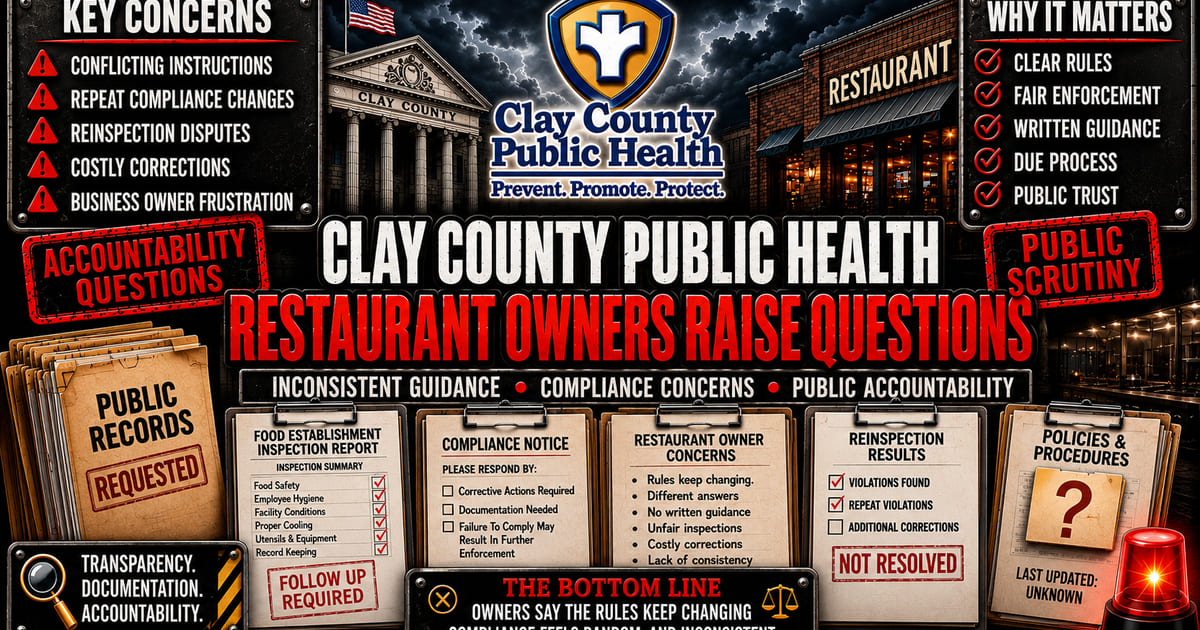
Clay County Public Health Has Some Explaining To Do
Restaurant owners in Clay County, Missouri are not asking for special treatment. They are asking for clear rules, consistent inspections, written direction, and fair enforcement from the government agency that has the power to disrupt their business.
That should not be controversial.
But based on conversations with multiple restaurant business owners, a troubling picture is starting to form around Clay County Public Health and the way its food inspection process is allegedly being handled in the real world.
Several business owners say they have been told to correct issues one way, only for inspectors to return later and tell them the work was wrong, incomplete, or now needed to be done differently. That kind of moving-target enforcement is not just frustrating. It is expensive. It creates confusion. It puts restaurants in a no-win situation. And if this pattern is happening across multiple businesses, Clay County residents deserve answers.
Food safety matters. Nobody serious is arguing otherwise. Restaurants should be clean. Food should be stored properly. Equipment should work. Employees should be trained. Real violations should be corrected.
But food safety cannot be used as a shield for sloppy enforcement, unclear communication, inconsistent direction, or government overreach.
When a health inspector tells a small business owner what must be fixed, that instruction should be specific, written, tied to the actual food code, and consistent from one inspection to the next. A restaurant owner should not have to guess what the Health Department wants. They should not be forced to spend money based on one instruction, then be told later that the instruction changed. They should not feel like passing inspection depends on which inspector shows up, what mood they are in, or how they personally interpret the rule that day.
That is not public health. That is bureaucratic chaos.
And when bureaucratic chaos lands on small businesses, it can destroy livelihoods.
Clay County Public Health has real power. It can inspect restaurants. It can cite violations. It can require corrections. It can affect permits. It can damage reputations. It can create delays. It can put pressure on owners who are already dealing with rising food costs, labor problems, rent, insurance, taxes, repairs, and day-to-day survival.
With that kind of power comes responsibility.
The Health Department does not get to operate like a mystery box where restaurant owners are left trying to decode shifting expectations. The rules need to be clear. The instructions need to be documented. The process needs to be fair. And if multiple owners are reporting the same pattern of inconsistent enforcement, the department should not dismiss that as complaining. It should be investigated.
Here is the core issue: a restaurant owner can follow the rules only if the rules are clearly explained and consistently applied.
If an inspector says, “Do this,” and the owner does it, then the department should not come back later and act like the owner failed because someone else wants it done another way. If there is a code section requiring a specific correction, put it in writing. If the correction changed, explain why. If the first instruction was wrong, admit it. If the business complied with prior written direction, do not punish them for relying on the government’s own guidance.
That is basic fairness.
Clay County Public Health owes restaurant owners more than vague direction and repeat visits that allegedly change the goalposts. It owes them documentation. It owes them consistency. It owes them professional communication. It owes them transparency.
And most importantly, it owes the public accountability.
Because this is not just about restaurant owners. This is about public trust.
When small businesses start saying the same thing — that they feel targeted, pressured, confused, or trapped in a cycle of changing compliance demands — the public should pay attention. Maybe every complaint has a reasonable explanation. Maybe some restaurants misunderstood the instructions. Maybe some corrections were tied to legitimate code requirements. That is possible.
But if Clay County Public Health is confident in its process, then the records should prove it.
Show the inspection reports. Show the written correction notices. Show the code sections cited. Show the reinspection notes. Show the appeal notices. Show how many businesses were given changed instructions after making corrections. Show whether complaints about inconsistent guidance were ever tracked, reviewed, or addressed.
Public agencies should not fear public records.
If Clay County Public Health is acting fairly, documentation will protect the department. If it is not, documentation will expose the pattern.
Restaurant owners should start saving everything immediately.
Save every inspection report. Save every email. Save every text. Save every voicemail. Take photos before and after corrections. Keep receipts and invoices for every repair or modification made because of an inspector’s instruction. Write down the name of every inspector, the date of every visit, and exactly what was said. If an inspector gives verbal direction, send a follow-up email asking them to confirm it in writing. If the direction changes later, document that too.
Because the only way to fight moving-target enforcement is with a paper trail.
Clay County Public Health needs to answer several simple questions:
Why are multiple restaurant owners reporting inconsistent inspection guidance?
Are inspectors required to cite the exact code section for every correction demand?
Are verbal instructions documented in writing?
What happens when one inspector tells a business to fix something one way, and another inspector later rejects that fix?
Does the department track complaints from businesses about inconsistent enforcement?
How many restaurants have appealed inspection-related enforcement actions?
How many businesses have been forced to spend money twice because the department changed direction?
Are business owners clearly informed of their appeal rights?
Who inside Clay County Public Health reviews inspector consistency?
These questions are not anti-food-safety. They are pro-accountability.
The public should want clean restaurants and clean government.
Clay County restaurant owners should not have to choose between protecting their business and staying silent out of fear that speaking up will bring more pressure. That is exactly why transparency matters. A government agency with enforcement power should never leave business owners feeling like they cannot question the process.
If the Health Department is right, prove it with records.
If restaurant owners are right, fix the system.
But what should not happen is silence, excuses, or business owners being brushed off while the same complaints keep surfacing.
Clay County Public Health has a credibility problem if multiple businesses are saying the rules keep changing after they try to comply. Whether that problem is caused by poor communication, weak leadership, inconsistent inspector training, unclear internal standards, or something worse, the department needs to address it publicly.
Small businesses deserve better than confusion.
Restaurant owners deserve better than moving targets.
The public deserves better than a health department that cannot clearly explain how its own enforcement decisions are being applied.
The bottom line is simple:
Food safety is important.
But government accountability is also important.
And when the agency responsible for enforcing the rules becomes the source of confusion, pressure, and distrust, it is time for Clay County Public Health to stop hiding behind the badge of public health and start answering questions.