Kansas City’s Two-Tier Business Policy: Power & Light vs. Westport
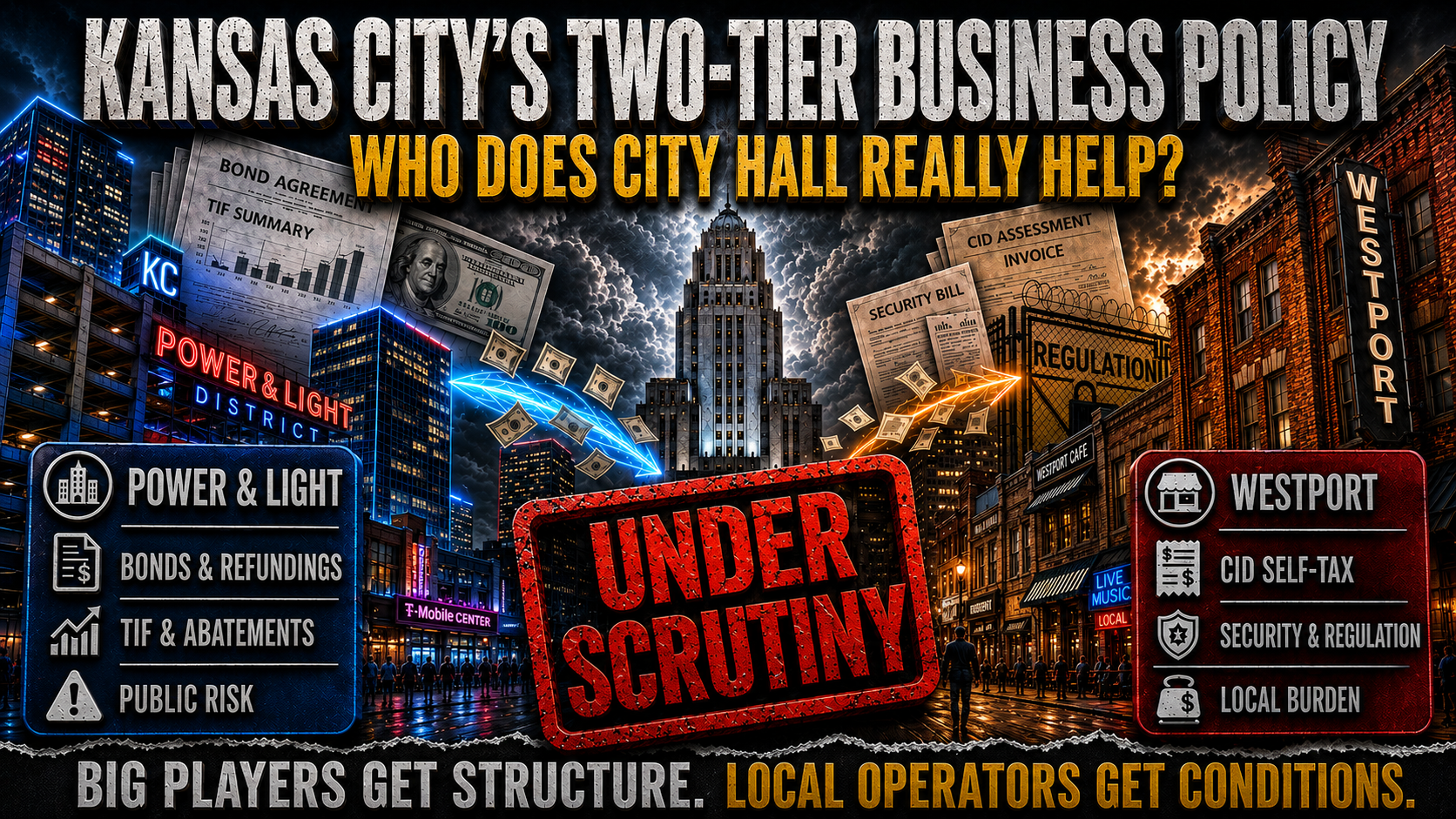
# Kansas City’s Two-Tier Business Policy
## Power & Light got public risk. Westport got local burden. World Cup bars got conditions.
Kansas City says it supports local business.
The record shows something more selective.
When Kansas City wanted a corporate-backed downtown entertainment district, it built a public-finance structure around Power & Light: bonds, refundings, tax-increment financing, abatements, public parking, and long-term debt management.
When Kansas City dealt with Westport, another entertainment district with local bars, older buildings, private operators, public-safety issues, and nightlife traffic, the model was different: self-taxing districts, security gates, sidewalk controls, zoning regulation, and local operating burden.
And when Missouri created a temporary World Cup alcohol-hours window that could directly help local bars, Kansas City did not simply let every licensed operator use the state-created opportunity. The city moved to control it, limit it, condition it, and require security-plan approval.
That is the story.
Not that Kansas City never helps business.
It does.
The real issue is who gets structure and who gets conditions.
## Power & Light got the public-finance model.
In 2004, Kansas City approved Ordinance 041302. That ordinance approved the issuance of Industrial Development Authority variable-rate demand tax-exempt revenue bonds for the Kansas City Downtown Redevelopment District, Series 2005, in an aggregate principal amount not to exceed $180,000,000.
That was not a small-business grant.
That was structural public finance.
The purpose was to finance redevelopment project costs. The district later became part of the public-finance history behind the Power & Light District.
The May 2026 Power & Light investigative report reconstructs the broader financing stack at about $295 million in original 2005–2006 bond issuance. The same report identifies roughly $199 million in cumulative general-fund subsidy through FY2025, roughly $97 million in TIF property-tax and sales/earnings-tax diversions, roughly $110 million in tower garage bonds and abatements, and roughly $106 million in MODESA state-tax diversion.
Important caveat: the report’s $806 million figure is not a clean cash-spent number. It is not one single check. It is a gross stack of identified public commitments, subsidies, diversions, abatements, and exposure. The report itself states the categories are not strictly additive.
But the core fact remains: Kansas City built a public-risk financing structure around Power & Light.
That is not what ordinary local operators get.
## The debt story did not disappear.
Kansas City was still handling Power & Light-related debt in 2026.
Ordinance 260238, passed March 5, 2026, authorized special-obligation bonds, including Series 2026C bonds to refund part of outstanding Series 2011A debt tied to the Kansas City Downtown Redevelopment District.
The ordinance traces the debt chain back to Industrial Development Authority Series 2005B, 2006A, and 2006B bonds issued to pay part of the cost of a downtown retail/entertainment district, infrastructure improvements, and public parking facilities.
That matters.
The Power & Light financing did not end when the ribbon was cut. It became a long-term public-finance obligation that had to be refinanced, restructured, and carried forward.
The 2026 ordinance says the bonds are special, limited obligations payable from appropriated money and are not a pledge of the city’s full faith and credit. That distinction is important. These are not voter-approved general-obligation bonds.
But they are still public obligations tied to city appropriation-backed financing.
That is a level of structural help local bars and independent entertainment districts do not receive.
## Westport got a different government.
Westport was not treated like Power & Light.
Westport did not get a comparable Power & Light-scale city-backed bond, TIF, or long-term abatement package for its entertainment core. That is the careful claim. It does not mean Westport received no government action at all. It means the type of government action was different.
Power & Light got public-risk finance.
Westport got a self-taxing and regulatory model.
Kansas City created the Westport Community Improvement District in 2003. A CID is not the same thing as a city bailout. A CID raises money inside the district through taxes or assessments. In plain English: the district helps pay for itself.
Kansas City’s FY2025 Community Improvement District annual report shows Westport CID I collected $1,738,036.13 in FY2025 revenue.
The same report shows Westport CID II collected $1,144,565.45 in FY2025 revenue.
Combined, Westport’s two CIDs collected about $2.88 million in FY2025.
That is not the city absorbing Westport’s risk.
That is Westport raising local money through its own district mechanisms.
## The Power & Light-area CID proves the double standard.
The cleanest comparison is not just Westport CID versus no CID.
Power & Light’s area has a CID too.
Kansas City’s FY2025 CID report shows the 1200 Main/South Loop Community Improvement District collected $954,959.15 in FY2025 revenue and spent $945,068.15.
The same report says the 1200 Main/South Loop CID did not provide services during the fiscal year. It says revenues were used for disbursement to the developer, transfer to the Special Allocation Fund, and administrative and operating costs.
That is the core contrast.
Westport’s CID revenue is tied to district operations and local burden.
The 1200 Main/South Loop CID revenue sits inside a developer-disbursement and public-finance structure.
Same kind of tool.
Different purpose.
Different beneficiary.
Different result.
## Westport got gates, not a bailout.
When Kansas City acted directly on Westport, the action was not a Power & Light-style subsidy package.
It was control.
In 2020, Kansas City adopted Resolution 200035. The resolution accepted the City Plan Commission recommendation to allow the Westport CID to continue the security-screening program in Westport and not exercise the city’s option to terminate the vacation of sidewalks on Westport Road and Pennsylvania Avenue.
That is a very different kind of help.
Power & Light got a financial structure.
Westport got a security-screening structure.
One district got public-risk tools.
The other got gates.
This is the pattern: when the city wants to build something for the big players, it writes finance documents. When the city wants to manage local nightlife, it writes rules.
## The World Cup bar-hours fight shows the same pattern in real time.
Missouri created a temporary World Cup alcohol-hours window.
Section 311.2026, RSMo, allows qualifying licensed on-premises establishments during the 2026 FIFA World Cup, from June 11 through July 19, 2026, to operate 24 hours a day and sell, serve, and allow alcohol consumption from 6:00 a.m. to 5:00 a.m. the following day. The statute says licensees do not need a special temporary state permit, subject to local restrictions. It also lets cities opt out or modify the hours by ordinance.
That means Missouri created a direct earning opportunity for licensed bars and restaurants.
Kansas City did not simply leave that opportunity alone.
Mayor Quinton Lucas sponsored Ordinance 260447. KSHB reported that Lucas introduced the ordinance to exempt Kansas City from the extended hours, citing safety concerns and prior gun-violence issues around bar closing time.
After debate, the ordinance passed as a committee substitute and as amended on May 14, 2026. The final version partially exempts Kansas City from the state law. It allows eligible license holders to operate until 3:00 a.m. citywide during the World Cup period. It also allows license holders in specified areas — including the Central Business District, Country Club Plaza, Crossroads, and Westport — to operate until 5:00 a.m. if they submit a security plan to the city and Kansas City Police Department by June 1, 2026.
That is not the same as the original state-created open window.
It is a controlled city version.
The city moved from state-created opportunity to city-conditioned permission.
## Blue Line shows the cost to local business.
KSHB placed the issue directly at Blue Line Hockey Bar in the River Market.
Owner Steve Stegall said he expected once-in-a-lifetime World Cup profit. He said that when he heard bars could extend hours to 5:00 a.m., he hired extra seasonal staff, and that he would have to let those workers go if extended hours were blocked.
KCTV reported that Stegall estimated the mayor’s World Cup hours decision could cost his business close to $100,000.
That number is an owner estimate, not an audited loss figure.
But the policy problem is clear.
A local business prepared for a revenue window created by state law. City Hall responded by putting the window back under city control.
That is the same policy instinct shown in the Westport comparison: local operators do not get open structure. They get conditions.
## The city’s small-business message does not match the structure.
Kansas City can point to small-business programs. That is fair.
The city has grants, storefront programs, technical assistance, district tools, and curated opportunities.
But a grant application is not a bond package.
A storefront program is not a 25-year abatement.
A self-taxing CID is not a bailout.
A security gate is not a parking subsidy.
A local bar’s security plan is not the same thing as city-backed development finance.
This is why the “Kansas City supports local business” message falls apart under scrutiny.
The city does support some local businesses in some ways.
But the help is usually limited, competitive, conditional, application-based, or regulatory.
For selected large projects, the help becomes structural.
That is the difference.
## The bias is on the books.
This is not about proving a secret conspiracy.
You do not need a secret email to see the two-tier system.
It is in the ordinances.
It is in the bond records.
It is in the CID reports.
It is in the refunding chain.
It is in the difference between a district that gets public-risk finance and a district that gets self-taxing, gates, security costs, and regulation.
The city’s preference is written through process.
Large projects get financing structures.
Global events get public-service agreements and city management.
Official opportunities get application structures.
Local operators get compliance structures.
That is the bias.
## What the record proves.
The record proves Kansas City approved major bond authorization for the Kansas City Downtown Redevelopment District.
The record proves Kansas City was still refunding downtown redevelopment district debt tied to the Power & Light financing chain in 2026.
The record proves Westport CID I and Westport CID II collected roughly $2.88 million combined in FY2025 through district mechanisms.
The record proves the 1200 Main/South Loop CID collected nearly $1 million in FY2025 and that its annual report stated no services were provided, with revenue used for developer disbursement, transfer to the Special Allocation Fund, and administrative and operating costs.
The record proves Kansas City allowed Westport’s security-screening program to continue.
The record proves Missouri created a temporary World Cup 23-hour alcohol-service window.
The record proves Kansas City passed a modified, city-controlled version of that opportunity, with 3:00 a.m. citywide hours and 5:00 a.m. permission only in specified areas with a security plan.
The record supports one conclusion: Kansas City does not apply one neutral business policy. It applies different models depending on who is asking and what kind of district is involved.
## What the record does not prove.
The record does not prove every Power & Light business is bad.
The record does not prove every Westport operator is good.
The record does not prove every city official acted with corrupt intent.
The record does not prove Westport received zero government action.
The record does not prove the city can ignore public safety.
The record proves something narrower and stronger: Kansas City built public-risk finance around Power & Light, left Westport with self-taxing and regulation, and handled the World Cup bar-hours opportunity as a controlled permission system rather than a broad small-business revenue opening.
That is enough.
## Bottom line.
Kansas City’s small-business problem is not a lack of slogans.
It is a policy structure.
Power & Light got bonds, refundings, TIF, abatements, parking support, and long-term public exposure.
Westport got CIDs, gates, security costs, zoning pressure, and local burden.
World Cup bar operators got a state-created opportunity narrowed into city-managed conditions.
That is not equal treatment.
That is not a neutral pro-business policy.
That is selected-business government.
Big players get structure.
Local operators get conditions.
And the proof is on the books.
## Sources
KCMO Ordinance 041302 — Industrial Development Authority bonds for the Kansas City Downtown Redevelopment District:
https://kansascity.legistar.com/LegislationDetail.aspx?From=RSS&G=D2E89A09-8736-4EFB-B4AE-572E0903BD5A&GUID=9EE54BC6-387B-4FDD-8519-3C1AFF62CF8E&ID=5500728
KCMO Ordinance 260238 — Series 2026 special-obligation bonds, including Series 2026C refunding tied to the Kansas City Downtown Redevelopment District:
https://clerk.kcmo.gov/LegislationDetail.aspx?FullText=1&GUID=7101AD16-C01E-4735-B141-FBE21F766EB7&ID=7931493&Options=&Search=
KCMO FY2025 Community Improvement District Annual Report:
https://www.kcmo.gov/home/showpublisheddocument/15892/638991543641570000
KCMO Resolution 200035 — continuation of Westport security-screening program:
https://clerk.kcmo.gov/LegislationDetail.aspx?GUID=BDEA1616-A8E3-4A4F-BADF-B8E013B0DB08&ID=5516372&Options=&Search=
Missouri Revised Statutes, Section 311.2026 — temporary FIFA World Cup alcohol-hours law:
https://revisor.mo.gov/main/OneSection.aspx?section=311.2026
KCMO Ordinance 260447 — committee substitute as amended, World Cup liquor-license hours:
https://kansascity.legistar.com/LegislationDetail.aspx?GUID=FA6F82BC-8035-40DA-9BF8-CA12E9795B06&ID=8006009
KSHB — World Cup bar-hours debate and Blue Line Hockey Bar owner comments:
https://www.kshb.com/sports/world-cup/should-kcmo-bars-stay-open-for-23-hours-during-the-world-cup-residents-and-businesses-weigh-in
KCTV5 — Blue Line owner estimated financial impact:
https://www.kctv5.com/2026/05/08/kansas-city-bar-owner-says-mayors-world-cup-hours-decision-will-cost-his-business-thousands/
Source reports reviewed:
KC Power & Light Investigative Report, May 2026.
Westport vs. Power & Light Comparison Report, May 2026.