Kansas City’s $43.6 Million Southwest Boulevard Gamble: Fewer Lanes, More Spending, Less Accountability
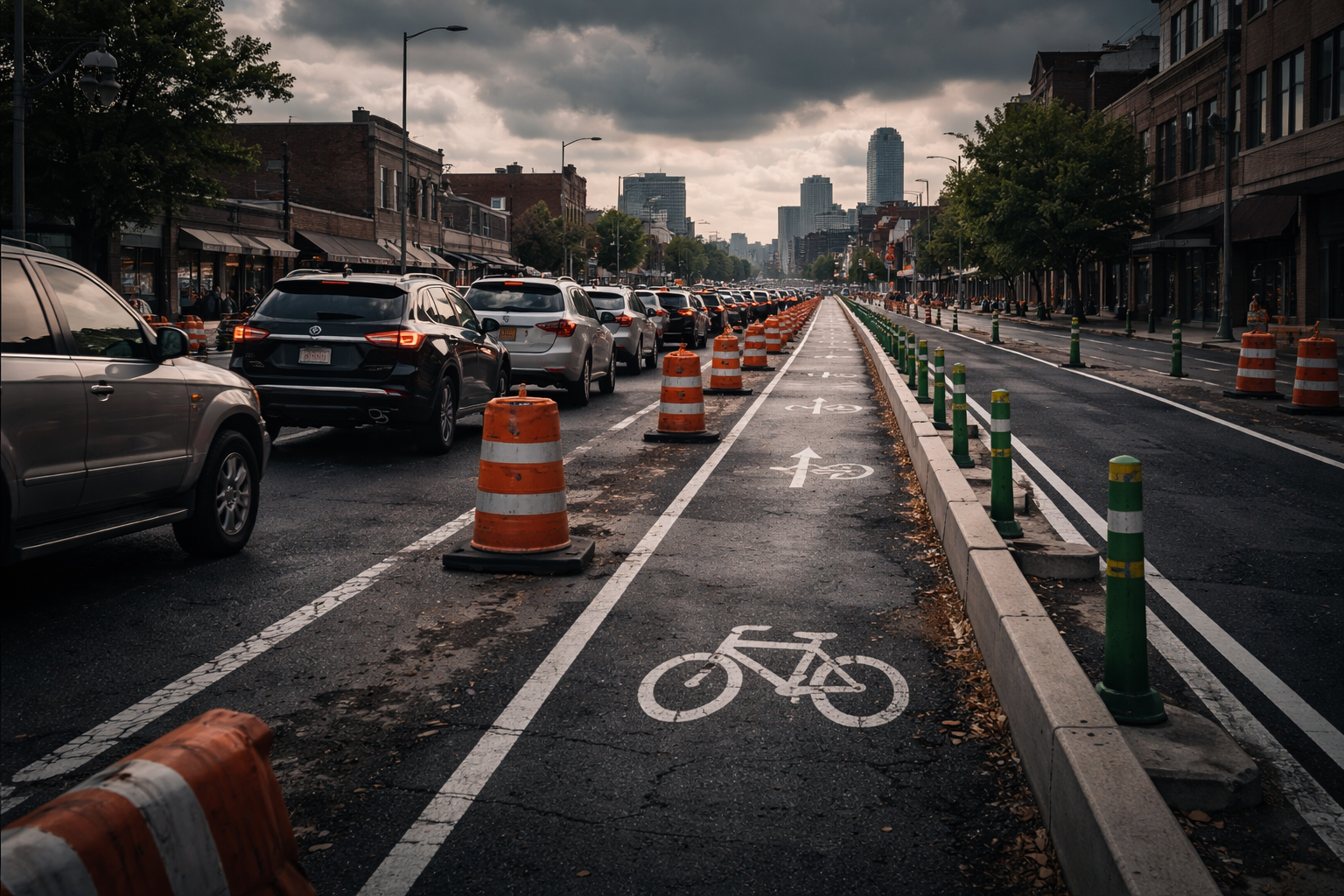
KANSAS CITY’S SOUTHWEST BOULEVARD GAMBLE: MILLIONS SPENT, LANES REDUCED, AND TAXPAYERS LEFT HOLDING THE BILL
Kansas City keeps selling the same story: spend more money, narrow more roads, take away more vehicle capacity, and call it “progress.”
Now that story is playing out again on Southwest Boulevard.
This is not some sleepy side street. This is a real commercial corridor and a real traffic route. Planning records for the Southwest/31st area show Southwest Boulevard carrying roughly 16,250 vehicles per day in the study area. The same planning documents describe the corridor as one that heavily favors automobile traffic. In plain English, this is a street people actually use.
And what is the city doing with it?
The city’s Southwest Boulevard project says it is converting portions of the corridor from four through-lanes to two through-lanes with a center turn lane while adding dedicated mobility space, including a separated lane for cyclists and pedestrians. City Hall calls this safety. But taxpayers are entitled to ask an obvious question: when a corridor carries that kind of traffic, how does reducing general traffic lanes make common sense for the people who rely on it every day?
That question gets even more serious when money enters the picture.
Kansas City says the broader Southwest Boulevard improvement effort involves more than $43.6 million in total investment. Not thousands. Not a minor repainting job. More than forty-three million dollars. City materials say that package includes flood storage, water main work, signals, streetscape upgrades, roadway work, and shared-use path improvements.
So let’s be honest about what this is: this is not a tiny bike lane tweak. This is a major corridor intervention with a major public price tag.
And it is happening while Kansas City is under real budget pressure.
City officials and local reporting have said Kansas City faced a projected budget shortfall of roughly $100 million before reducing it to about $64.1 million. At the same time, infrastructure budgets have been squeezed and city leaders have had to make choices about what gets funded, what gets delayed, and what taxpayers are told to accept.
That is where the accountability issue starts.
Because if the city is tight on money, taxpayers should not be mocked or brushed aside for asking why tens of millions are going into corridor redesigns that reduce vehicle capacity on heavily traveled streets. That is not anti-safety. That is basic adult supervision over public spending.
And Kansas City does not get the benefit of the doubt here, because this is not the first time bike-lane and lane-reduction policy has triggered backlash.
On Truman Road, the city had to confront serious public criticism after installing bike lanes that business owners and some officials said created safety concerns, access problems, parking conflicts, loading issues, and economic harm. The city paused work, and removal or redesign became part of the debate. Whether someone personally loves bike lanes or hates them is irrelevant. The point is simple: Kansas City already has a documented history of rolling out these ideas, getting hit with backlash, and then acting shocked when real-world consequences show up.
That matters on Southwest Boulevard because it destroys the fantasy that every one of these projects is automatically smart just because it comes wrapped in planning jargon.
The city’s defenders will say this corridor is dangerous, and they are not wrong to raise safety concerns. But safety cannot become a magic word that ends every debate. Once government starts spending tens of millions of dollars and reengineering major roads, the public has every right to demand hard proof, corridor by corridor, that the tradeoff is worth it.
Show the before-and-after data.
Show the traffic modeling.
Show the business impact.
Show the measurable demand for the mobility infrastructure.
Show the evidence that this will work better for the public than what existed before.
And if the city cannot clearly and persuasively do that, then taxpayers are justified in seeing this for what it looks like: another expensive planning experiment imposed on people who still have to drive, deliver, commute, park, and run businesses in the real world.
That is the deeper frustration in Kansas City right now.
Residents are constantly told there is not enough money.
Businesses are told to be patient.
Taxpayers are told to trust the experts.
Drivers are told to adjust.
And then, somehow, there is always money for another redesign, another study, another lane conversion, another theory about how people should move instead of how they actually move.
That is not accountability.
That is ideology with a public invoice.
No serious person is arguing that streets should be unsafe. The issue is whether Kansas City leadership has earned enough trust to keep forcing costly transportation redesigns onto major corridors while the city is under budget strain and while previous lane projects have already shown how badly these ideas can collide with business access, traffic reality, and public confidence.
That is the real story on Southwest Boulevard.
Not that safety does not matter.
Not that every bike lane is evil.
Not that change is impossible.
The real story is that Kansas City keeps making high-cost, high-impact decisions on behalf of taxpayers without first proving that the disruption, the lane reduction, and the spending will produce results strong enough to justify the cost.
And when government keeps demanding trust after previous backlash, previous reversals, and ongoing budget stress, skepticism is not unreasonable.
It is common sense.