Kansas City U.S. 71 Reconnection Plan Exposed: Cost, Failures, and Unfunded Reality
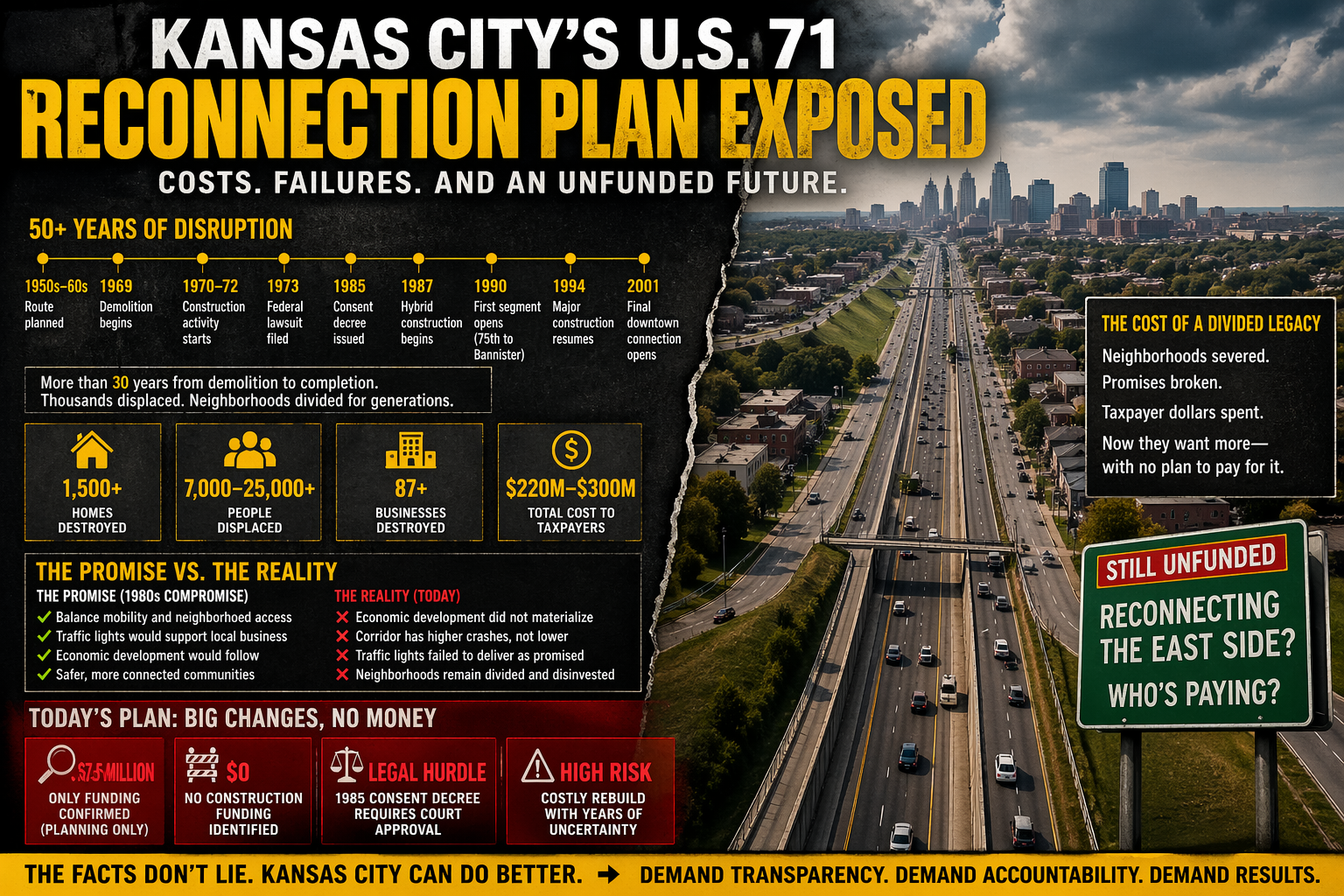
Kansas City is attempting to sell a major redesign of U.S. 71 / Bruce R. Watkins Drive as a long-overdue “reconnection” effort. The problem is simple: the facts show this is not a funded infrastructure project. It is a concept built on top of one of the most expensive, disruptive, and historically failed highway decisions the city has ever made.
Start with the timeline. Officials often describe U.S. 71 as a project of the 1990s and early 2000s. That is incomplete. Demolition along the corridor began in 1969. Construction activity dates back to the early 1970s. A federal lawsuit was filed in 1973. A court-imposed consent decree in 1985 forced a compromise design. Segments opened starting in 1990. The final downtown connection was not completed until 2001.
That is not a normal project timeline. That is more than 30 years of disruption, delay, and litigation.
During that period, thousands of residents were displaced. Estimates vary, but official and historical sources indicate over 1,500 homes, hundreds of duplexes and apartments, and dozens of businesses were removed. Some estimates place total displacement at more than 7,000 people, with broader impact figures reaching far higher. Entire neighborhoods were cleared, and in some cases the land sat vacant for decades before construction resumed.
This matters because the current “reconnection” narrative frames the damage as something historical and contained. It was not. It was prolonged, and it was partially the result of government indecision and delay after demolition had already occurred.
Now look at cost versus outcome. The original corridor cost roughly $220 million to $300 million when factoring in land acquisition, design, and construction. That is a significant public investment. The justification for the compromise design—signals instead of a full freeway—was that it would balance mobility with neighborhood access and economic development.
That did not happen.
Current project materials openly state that the traffic-light compromise failed to generate the economic development it was supposed to produce. Safety is now cited as a major issue, with the corridor identified as one of the city’s most dangerous for pedestrians and cyclists. In other words, the city is now acknowledging that the original design failed on both economic and safety metrics.
That is not a minor adjustment. That is a reversal of the original justification.
Now examine the current proposal.
The “Reconnecting the East Side” effort is still in planning. The only confirmed funding is approximately $7.5 million for study, legal work, and early design phases. There is no identified funding for final design or construction. The corridor is listed on Missouri’s unfunded needs list.
Despite that, the concept being advanced—particularly the hybrid “parkway” option—would require major reconstruction. That includes removing traffic signals, adding grade separation, constructing bridges, and potentially lowering sections of the roadway. That is capital-intensive infrastructure, not incremental improvement.
There is a direct contradiction here: large-scale construction is being discussed without a committed funding source.
There is also a legal barrier. The 1985 consent decree still governs key aspects of the corridor. Any major redesign will require legal action to modify or remove those constraints. That introduces risk, delay, and uncertainty before construction can even begin.
Traffic impacts are another tradeoff. Modeling from the project itself shows that while certain alternatives may improve flow on U.S. 71, they also shift traffic onto surrounding corridors. There is no version of this plan that improves everything everywhere. Gains in one area create pressure in another.
The most important contradiction is conceptual.
The city is framing this as a “reconnection” project while advancing options that move the corridor closer to freeway conditions. A fully signal-free corridor improves regional traffic movement. It does not automatically restore neighborhood connectivity. That depends entirely on the quality, frequency, and usability of crossings—and those details are not yet finalized.
At the same time, the project promotes redevelopment potential along the corridor. That raises a separate risk: increased land value without guaranteed protections for existing residents. Current materials discuss housing and business opportunities, but do not establish binding, enforceable anti-displacement mechanisms tied to the infrastructure investment.
That gap matters. Infrastructure projects create value. Without safeguards, that value does not automatically stay with the communities that were originally harmed.
Finally, consider the timeline going forward. The project is expected to enter environmental review and preliminary design between 2026 and 2028. There is no confirmed schedule for construction beyond that. Even under optimistic assumptions, this is years away from execution.
So the reality is this:
Kansas City is attempting to redesign a corridor that took over 30 years to build, displaced thousands of residents, cost hundreds of millions of dollars, and failed to deliver its promised economic benefits. The new plan acknowledges those failures—but does not yet have funding, legal clearance, or a finalized design capable of correcting them.
Until those pieces are in place, this is not a reconstruction project.
It is a proposal built on a documented history of disruption, delay, and unmet promises.