Kansas City Sideshows, Police Chase Policies, and the Public Safety Gap Criminals Exploit
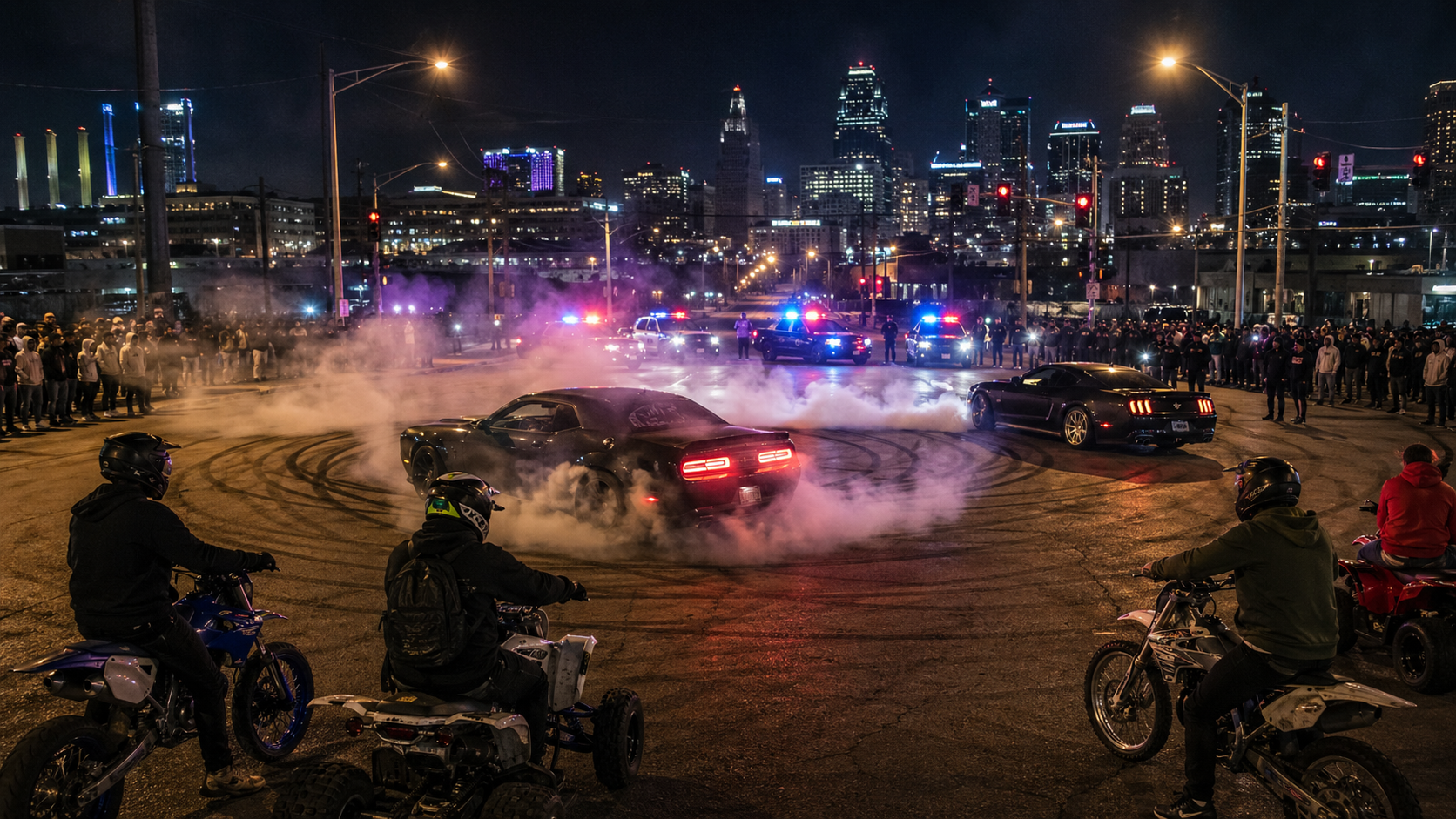
Kansas City’s Sideshow Crisis Exposes the Hole in Local Law Enforcement: Criminals Know Police Often Cannot Chase
Kansas City has spent years trying to stop illegal sideshows, street takeovers, reckless stunt driving, ATVs, dirt bikes, and street racing. The city has passed new ordinances, increased tow fees, authorized spectator vehicle towing, installed street deterrents, and backed multi-agency crackdowns. Yet the same problem keeps returning: crowds block streets, vehicles do donuts in public intersections, ATVs run through traffic, officers are forced into dangerous split-second decisions, and ordinary residents and businesses are left asking why the city cannot get control of its own streets.
The answer is not simple, but it is clear: Kansas City is trying to fight a mobile, crowd-driven, social-media-fueled public-safety problem with laws that often work after the fact, not during the event itself. Police can cite. Police can tow. Police can arrest when they can safely identify suspects. But when suspects flee, the entire enforcement equation changes.
KCPD does not have a true “no chase” policy. The accurate description is a restrictive pursuit policy. KCPD’s public pursuit directive states that officers will not initiate a vehicle pursuit for a serious traffic violation, DUI, or stolen auto unless the suspect vehicle or occupants have been involved in a dangerous felony, or unless the suspect vehicle or occupants present a clear and immediate danger to the safety of others. The same policy defines a dangerous felony as a felony involving an actual or threatened attack that could result in death or serious bodily injury, including examples such as aggravated assault on law enforcement, murder, rape, and robbery.
That distinction matters. It is inaccurate to claim Kansas City City Council banned police chases. City Council did not directly write KCPD’s pursuit policy. KCPD operates under the Kansas City Board of Police Commissioners, not ordinary local control by City Council. The more accurate statement is that lawsuits, crash risk, public liability, and the danger of innocent people being injured or killed have shaped restrictive pursuit policies, while City Council separately passed sideshow penalties, spectator enforcement tools, and tow-fee measures.
Those policies exist for a reason. Police chases can kill innocent people. They can turn a reckless driver into a deadly crash. They can create lawsuits, settlements, and public payouts that taxpayers ultimately feel. No serious person should want officers blindly chasing every fleeing car, ATV, or dirt bike through crowded city streets.
But the practical street-level result is also obvious: when criminals, reckless drivers, ATV riders, stolen-car drivers, and sideshow participants know officers are limited in when they can pursue, some of them act like the streets belong to them.
That is the hole in the system. The law and policy require the officer to weigh the danger of the chase against the danger of letting the suspect go. Criminals understand that. They understand that if the original conduct is a traffic violation, reckless driving, stunt driving, illegal ATV riding, or a sideshow violation, police may not be able to chase unless the facts rise to a dangerous felony or present a clear and immediate danger. That does not mean police are powerless, but it does mean officers are often forced to watch offenders flee, gather evidence later, and hope cameras, license plate readers, drones, witnesses, tow authority, or future arrests can finish the job.
Jackson County has faced the same problem. In 2019, Sheriff Darryl Forté announced a more restrictive vehicle pursuit policy after a Jackson County deputy was charged in connection with a May 2018 pursuit crash that seriously injured an innocent bystander. Public reporting at the time said the Jackson County Sheriff’s Office had suspended vehicle pursuits during a policy review and later established a restrictive pursuit policy. The previous Jackson County Sheriff’s Office policy reportedly said deputies would not initiate pursuits for traffic violations, impaired driving, or stolen autos unless the suspect vehicle or occupants had been involved in a dangerous felony or created an immediate danger to others.
That history matters because it shows why these policies exist. They were not created in a vacuum. They were created in the shadow of crashes, injuries, lawsuits, criminal charges, settlements, and public liability. So the public is stuck with two bad realities at the same time. If police chase aggressively, innocent people can be maimed or killed. If police do not chase, offenders learn that running can work. That is the center of Kansas City’s street-takeover problem.
Kansas City City Council has not ignored the issue. In September 2024, the Council passed Ordinance 240724, sponsored by Mayor Quinton Lucas, Crispin Rea, and Wes Rogers, amending the city code to strengthen enforcement against street racing and sideshows. The ordinance directly recognized that street racing and sideshows have caused or contributed to crashes, deaths, injuries, property damage, noise disturbances, vandalism, litter, loss of commercial revenue, and damage to public streets. It also recognized that crowds can obstruct or intimidate potential customers and hurt businesses.
That ordinance was a serious move. It allowed Kansas City to target not only drivers but also spectators. Under the ordinance, police may tow and impound vehicles tied to illegal street racing and sideshows, including vehicles connected to spectators. Spectator enforcement matters because sideshows are not created by drivers alone. They survive because crowds show up, film, cheer, block streets, and give reckless drivers the attention they want.
The city later finalized administrative tow fees for vehicles involved in illegal sideshows and street racing: $500 for a first offense, $750 for a second offense, and $1,000 for a third or subsequent offense. Those fees apply to the enforcement structure Kansas City built around illegal street racing, sideshows, and related spectator activity. That gives police and the city a financial deterrent stronger than a minor ticket.
Those penalties matter. A driver doing donuts in an empty intersection is one problem. A driver doing donuts inside a crowd with spectators, guns, stolen cars, ATVs, dirt bikes, blocked intersections, and emergency access problems is a different threat entirely.
But tow fees and citations are not the same as immediate control. A sideshow can form quickly. Drivers can scatter quickly. ATVs and dirt bikes can flee into alleys, sidewalks, parks, and traffic. Crowds can move to the next intersection. Officers cannot simply chase every vehicle without risking the exact type of catastrophic crash these policies were written to prevent.
That is why Kansas City’s current approach depends on indirect enforcement: tow vehicles, target spectators, use cameras, use drones, use license plate readers, recover guns, coordinate with Missouri State Highway Patrol and neighboring agencies, and build cases after the event. That strategy can work, but it is slower than the chaos happening in real time.
Missouri law also complicates the public’s understanding. Fleeing from police can be a crime, but that does not automatically mean every fleeing traffic violator becomes the type of dangerous felony pursuit policies were designed around. The officer still has to decide whether initiating or continuing a pursuit creates more danger than letting the suspect go. That is where the enforcement gap opens.
The most honest way to describe the problem is this: Kansas City does not have a lack of laws. It has a real-time enforcement problem. The city can punish people after the fact, but it cannot always safely stop them in the moment. And the people causing the problem know it.
This is not an argument for reckless police chases through crowded streets. That would be stupid. A chase policy with no limits would eventually kill innocent people and cost taxpayers millions. But a policy that is too restrictive creates its own danger. It tells the worst actors that if they run fast enough, scatter quickly enough, or stay just below the dangerous-felony line, they may escape immediate consequences.
That is why Kansas City’s sideshow problem is bigger than cars doing donuts. It is a test of whether the city can maintain public order without turning every fleeing vehicle into a deadly pursuit. It is a test of whether police have the tools to stop offenders without creating more victims. It is a test of whether City Hall, KCPD, the Police Board, Jackson County, prosecutors, and regional agencies can close the gap between “we know who they are” and “we actually stopped them.”
The current system is built around liability control. That protects innocent drivers from dangerous chases. But it also creates a visible weakness on the street. Kansas City residents see the result: blocked intersections, reckless drivers, ATVs ignoring police, spectators treating public streets like private arenas, and officers forced to operate under rules that often prevent immediate pursuit unless the facts rise to a serious threshold.
The hard truth is that criminals do not need to read the policy manual. They learn from experience. If people run and do not get chased, the message spreads. If ATVs scatter and police back off, the message spreads. If sideshows break up and reform somewhere else, the message spreads. Every time the system relies on later enforcement instead of immediate control, the street-level culture gets bolder.
Kansas City leaders can point to ordinances, tow fees, and enforcement operations. Some of that is justified. The city did pass stronger laws. Police have towed vehicles. Officers have made arrests. Agencies have recovered guns. But none of that changes the central weakness: when offenders flee, officers are constrained by pursuit policies designed to prevent lawsuits, injuries, and death. Those policies are rational. They are also being exploited.
Kansas City does not need reckless chasing. It needs smarter containment, faster identification, heavier consequences, stronger prosecution, better camera coverage, more targeted towing, stronger coordination with Jackson County and state agencies, and real public reporting on how many people are actually charged and convicted after these events.
Until then, the city is fighting sideshows with one hand tied behind its back. The criminals know it. The officers know it. The residents know it. And every business sitting near a takeover zone pays the price.