Kansas City Keeps Paying Lawsuit Settlements While City Hall Dodges Accountability
Kansas City Keeps Paying Lawsuit Settlements While City Hall Dodges Accountability
Kansas City has a lawsuit problem.
Not a small one. Not a one-time mistake. Not a random accident.
A pattern.
The City gets sued. The City settles. The City pays. Taxpayers absorb the damage. Then City Hall moves on like the check came from nowhere.
But the money does not come from nowhere.
It comes from public funds. It comes from liability funds. It comes from legal expense accounts. It comes from workers’ compensation funds. It comes from budgets that could otherwise be used for public services, public safety, street repairs, inspections, neighborhood improvements, and basic city operations.
The question is not simply, “How much did Kansas City pay?”
The real question is: what changed after the City wrote the checks?
Because if the answer is nothing, then these settlements are not just legal payouts.
They are the cost of bad management.
The City Manager Problem
Mario Vasquez became Kansas City City Manager effective May 8, 2025.
That date matters.
It would be inaccurate to say every lawsuit paid after May 8, 2025 was personally caused by Vasquez. Many lawsuits and claims were filed before he officially became City Manager.
But that does not let the City Manager’s office off the hook.
The City Manager is supposed to run the administration. The City Manager is supposed to make sure departments operate properly. The City Manager is supposed to identify risk, correct failures, enforce standards, and protect taxpayers from repeat exposure.
So the issue is not whether Vasquez personally caused every lawsuit.
The issue is whether the City Manager’s office is doing anything meaningful to stop the machine that keeps creating them.
Since Vasquez took office, Kansas City has continued approving major legal payouts.
Publicly Documented City Legal Payouts Since Mario Vasquez Became City Manager
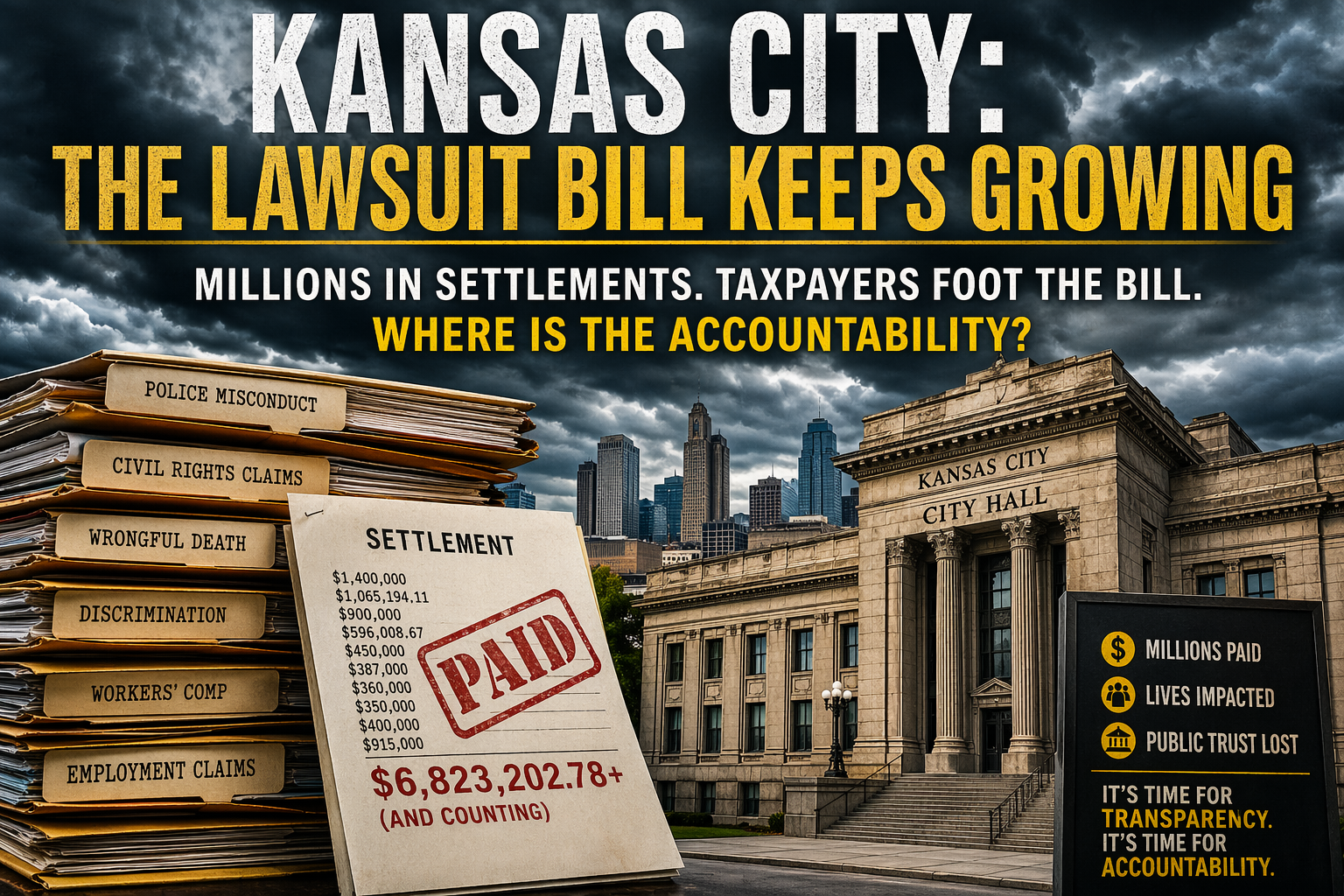
May 15, 2025 — Chris Hernandez v. City of Kansas City, Missouri, Case No. 2216-CV27734 — $1,400,000.00
May 15, 2025 — Frank Blake v. Richard Starks and City of Kansas City, Missouri, Case No. 22AE-CC00261 — $387,000.00
July 24, 2025 — Stephen Seals v. City of Kansas City, Missouri, Case No. 2316-CV21602 — $350,000.00
July 24, 2025 — Stephanie Collier-West workers’ compensation claim, Case No. 16-071678 — $400,000.00
July 31, 2025 — Rebecca Ann Brinker, dependent of Kyle Brinker, workers’ compensation claim, Case No. 24-066288 — $1,065,194.11
July 31, 2025 — Kerrie Tyndall v. City of Kansas City, Missouri, Case No. 2316-CV19161 — $900,000.00
December 18, 2025 — Debra Wolf v. City of Kansas City, Missouri, Case No. 2416-CV27002 — $596,008.67
Those seven publicly documented payouts alone total at least $5,098,202.78.
That number should not be treated as the full total. It is only the publicly confirmed minimum from City records reviewed so far.
And that is exactly the problem.
Why does a taxpayer have to dig through scattered council records, meeting agendas, ordinances, court dockets, news reports, and Sunshine Law requests just to find out how much public money Kansas City is paying out because of lawsuits, claims, settlements, judgments, workers’ compensation matters, police-related legal exposure, and administrative failures?
That should already be in one public dashboard.
The Federal Court Layer
The City’s ordinance records are only part of the story.
Kansas City also gets sued in federal court.
Federal cases matter because many civil-rights, employment, constitutional, police-related, retaliation, discrimination, due-process, and Section 1983 cases are filed in the United States District Court for the Western District of Missouri.
Those cases do not always show up cleanly in City Council records.
Some federal cases end with a stipulation of dismissal.
Some end with a dismissal with prejudice.
Some end after a settlement conference.
Some involve confidential settlement terms.
Some include attorney-fee payments.
Some may be paid through City legal funds, insurance, police-related accounts, or other internal finance channels.
That means City settlement ordinances alone do not prove the full cost.
One federal example is Sims v. City of Kansas City, Missouri, Case No. 4:22-cv-00717, filed in the Western District of Missouri on November 2, 2022, and terminated on March 24, 2023. Public federal docket sources identify it as a civil-rights employment case.
That does not mean the public record reviewed here confirms a payout in that specific federal case. It means federal court is a separate audit layer that must be reviewed before anyone can honestly claim they have the complete legal payout picture.
A complete audit requires checking:
Western District of Missouri federal dockets
PACER
CourtListener
Federal stipulated dismissals
Federal consent judgments
Federal settlement conference entries
Attorney-fee awards
City payment ledgers tied to federal case numbers
Risk Management records
Legal Expense Fund records
Public Official Liability Fund records
Police settlement records
Until Kansas City releases a complete payout ledger, the public cannot easily know how many federal cases were settled, how much was paid, which department caused the exposure, or what changed afterward.
That is not transparency.
That is a maze.
The Police Settlement Problem Is Even Bigger
The Kansas City Police Department settlement issue is a separate monster.
Recent reporting says KCPD has paid millions in legal settlements, including police-related lawsuits, wrongful death claims, civil-rights cases, workplace claims, and excessive-force-related matters.
Public reporting has stated that KCPD made 36 settlement payments in 2025 totaling $13.8 million.
Other reporting says KCPD had paid nearly $11 million in settlements during the current budget year despite only $2.5 million being allotted for settlements.
Other reporting has stated that KCPD paid $21 million in lawsuit settlements in 2025.
Whatever exact figure is ultimately confirmed through official ledgers, the message is obvious:
The police settlement problem is not small.
It is not controlled.
It is not transparent enough.
And it is draining public money.
The problem is made worse by Kansas City’s unusual police governance structure. KCPD is controlled by the Board of Police Commissioners, but Kansas City taxpayers still fund the department. That creates the worst possible accountability gap: taxpayers pay the bill, but direct local control is limited.
That does not mean City Hall gets to shrug.
If Kansas City taxpayers are paying, Kansas City taxpayers deserve a full public accounting.
Every police-related settlement should show:
Who was paid
How much was paid
What case it came from
What officer or unit was involved, where legally disclosable
What conduct created the exposure
Whether the employee was disciplined
Whether policy changed
Whether the same officer or unit was involved in prior claims
What fund paid the settlement
Whether the City Council had to backfill the cost
Without that, taxpayers are not getting accountability.
They are getting invoices.
City Hall’s Favorite Trick: Treat Every Lawsuit Like An Isolated Incident
This is how government avoids responsibility.
Every lawsuit becomes “just one case.”
Every settlement becomes “a business decision.”
Every payout becomes “recommended by the City Attorney and Risk Management.”
Every department failure gets buried under legal language.
Every large check becomes a line item.
But when the payouts keep stacking up, it is no longer believable to call them isolated.
A $1.4 million settlement is not nothing.
A $900,000 settlement is not nothing.
A $596,008.67 settlement is not nothing.
A $1,065,194.11 workers’ compensation settlement is not nothing.
Police settlement costs in the millions are not nothing.
These are public-money alarms.
And when the alarms keep going off, the person running the administration cannot act like the smoke is someone else’s problem.
The City Manager’s job is not just to sit at the top of the org chart.
The City Manager’s job is to manage.
That means identifying departments that keep creating legal exposure.
That means demanding after-action reviews.
That means forcing corrective action.
That means tracking repeat offenders.
That means showing the public whether lawsuits are coming from employment practices, police conduct, code enforcement, discrimination, workers’ compensation failures, retaliation claims, dangerous policies, poor supervision, or broken internal controls.
If City Hall does not track that publicly, then City Hall is choosing opacity over accountability.
The Real Issue: Lawsuit Payouts Are A Shadow Budget
Every lawsuit payout is more than a legal expense.
It is a shadow budget.
Money gets redirected after something goes wrong.
Taxpayers pay for the mistake after the damage is already done.
The public hears about the settlement, maybe sees an ordinance, maybe sees a news story, and then the issue disappears.
But the money does not disappear.
It is gone.
That money could have gone to streets, sidewalks, public safety, entertainment district security, inspections, neighborhood services, business support, municipal court operations, traffic safety, or basic maintenance.
Instead, it goes to clean up legal exposure.
That should make people angry.
Not because every plaintiff is wrong. Not because every settlement is illegitimate. Some people sue because government actually harmed them. Some people deserve to be compensated.
The scandal is not that injured people get paid.
The scandal is that Kansas City keeps creating conditions where lawsuits, claims, and legal disputes keep turning into major public payouts.
Where Is The Public Legal Payout Dashboard?
Kansas City should have a public legal payout dashboard.
Not scattered ordinances.
Not buried agendas.
Not vague committee records.
Not a system where taxpayers have to search Legistar, Clerk records, Case.net, PACER, CourtListener, news articles, and Sunshine requests just to understand where their money went.
The dashboard should show every lawsuit, claim, judgment, settlement, workers’ compensation payout, discrimination settlement, police-related settlement, and legal expense payment.
For each matter, it should show:
Case name
Case number
Department involved
Date approved
Date paid
Amount paid
Funding source
Type of claim
Whether the case settled or resulted in judgment
Whether the City admitted liability
Whether any employee discipline occurred
Whether any policy changed afterward
Whether the same department had similar prior claims
That is basic transparency.
If the City can track the payment internally, the public should be able to see the payout externally.
If City Hall refuses to provide that transparency voluntarily, then the public should assume the system benefits from staying confusing.
The Accountability Questions Mario Vasquez Should Answer
The City Manager should be asked directly:
Since May 8, 2025, how many legal payouts has Kansas City approved?
What is the total amount?
Which departments are responsible for the most legal exposure?
Which cases involved repeat conduct, repeat employees, repeat supervisors, or repeat policies?
What corrective actions were taken after each settlement?
What lawsuits or claims are currently pending that could create future payouts?
How much has the City budgeted for legal settlements, judgments, workers’ compensation, and police-related settlement exposure?
How many federal cases involving Kansas City have been settled since May 8, 2025?
How much has the City paid in federal-court-related settlements or attorney-fee awards?
Has the City created a public-facing legal payout dashboard?
If not, why not?
Those are not political questions.
Those are management questions.
And if the City Manager cannot answer them clearly, then the City has a management problem.
A City That Keeps Settling But Never Fully Explaining
Kansas City taxpayers are not just paying for lawsuits.
They are paying for silence.
They are paying for closed-door decisions.
They are paying for public records scattered across multiple systems.
They are paying for departments that create legal exposure and then move on.
They are paying for elected officials and administrators who talk about budget pressure while allowing lawsuit payouts to drain public resources.
The City cannot keep asking residents to trust the process when the process keeps producing million-dollar checks.
At some point, the public has the right to say:
Show us the full list.
Show us the departments.
Show us the federal cases.
Show us the police settlements.
Show us the funding sources.
Show us the reasons.
Show us the policy changes.
Show us who was held accountable.
And if nobody was held accountable, say that too.
Because Kansas City does not have a lawsuit problem only because people sue.
Kansas City has a lawsuit problem because City Hall keeps creating conditions that make lawsuits expensive.
And the City Manager’s office cannot stand at the top of the administration, watch the checks go out, and pretend this is just legal housekeeping.
It is not.
It is taxpayer money.
It is public accountability.
And it is time for Kansas City to stop hiding legal failure inside settlement ordinances and start telling the public exactly what these lawsuits are costing — and what City Hall is doing to make sure the next million-dollar payout does not happen again.