Kansas City Has Had 63 Years of the Earnings Tax. Why Should Voters Keep Trusting City Hall?
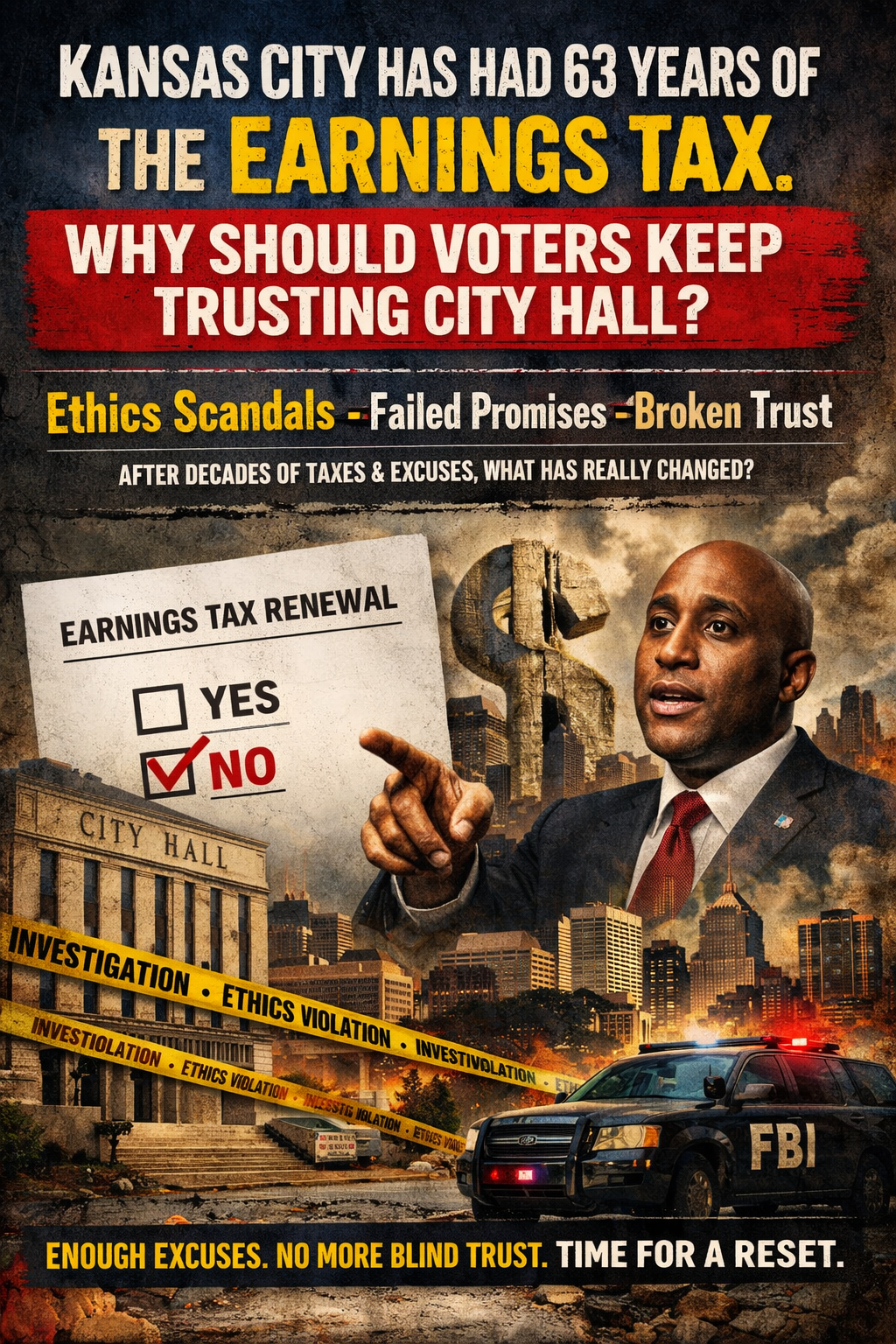
KANSAS CITY HAS HAD 63 YEARS OF THE EARNINGS TAX. WHAT EXACTLY ARE VOTERS GETTING FOR IT?
Kansas City voters are being told, once again, that they must renew the earnings tax or accept disaster.
That is always the pitch.
Panic.
Pressure.
Fear.
And the same recycled warning that if taxpayers do not keep feeding City Hall exactly what it wants, everything will fall apart.
After 63 years, that argument is wearing thin.
At some point, voters need to stop reacting to the fear campaign and start asking the question that actually matters:
What has City Hall done to earn another automatic yes?
Because that is what this really is.
Not just a tax vote.
Not just a budget vote.
Not just another ballot issue.
It is a trust vote.
And City Hall has a trust problem.
Nobody is denying that the earnings tax brings in money.
Nobody is denying that losing it would force hard choices.
Nobody is denying that government prefers predictable revenue.
That is not the point.
The point is that Kansas City leadership keeps demanding continued trust from the public while giving voters more and more reasons to doubt the judgment, discipline, honesty, and priorities of the people running this city.
That is why this issue hits harder than a normal tax debate.
Because this vote is happening in a city where public confidence has already been damaged by ethics questions, investigations, accusations, disclosure controversies, political smoke, and repeated credibility problems.
Let’s be exact, because accuracy matters.
There is not clear public proof that the mayor’s office abused power in connection with the earnings tax vote itself.
There is not a public record that conclusively proves criminal misconduct by Mayor Quinton Lucas himself.
But that does not save City Hall from the real problem.
The real problem is that there is already enough smoke around city leadership to make voters ask why they should keep writing checks to a system that has not earned their confidence.
That is the issue.
A government does not have to be criminally convicted to be politically untrustworthy.
A system does not have to collapse completely to be deeply broken.
And voters do not have to wait for handcuffs before deciding they are tired of funding dysfunction.
Kansas City residents have watched the same pattern for years:
more demands,
more excuses,
more spin,
more pressure,
more talk about what government needs,
and never enough honest reflection about what taxpayers are actually getting in return.
That is the scandal.
The earnings tax debate is not just about whether City Hall can collect money.
Of course it can.
The debate is whether City Hall deserves to keep collecting this much money while public confidence remains weak, skepticism remains justified, and the same political class keeps acting like voter frustration is the problem instead of government performance.
That mindset is exactly why so many people are fed up.
The tax has been around for decades.
If six decades of special taxing authority still does not produce obvious trust, obvious confidence, and obvious proof of competent stewardship, then the problem is not the voters.
The problem is the government.
And that is what the defenders of the status quo never want to confront.
They want voters focused on fear.
They want voters thinking only about short-term disruption.
They want taxpayers to believe that forcing City Hall to adapt is somehow reckless, while allowing the same machine to run indefinitely is somehow responsible.
No.
What is reckless is asking working people to keep funding the same structure forever while treating accountability like an inconvenience.
What is reckless is pretending this tax must continue simply because leadership never built a better long-term model.
What is reckless is normalizing a culture where government’s answer to every trust problem is: pay us again and ask fewer questions.
That is not good government.
That is dependency.
If the earnings tax fails, Kansas City will be forced to make choices.
Good.
It should be forced to make choices.
It should be forced to prioritize.
It should be forced to justify spending.
It should be forced to cut waste.
It should be forced to expand the business base.
It should be forced to think beyond squeezing the same residents and workers every cycle.
It should be forced to build a fairer, more balanced, more credible system.
That is what real reform looks like.
Not slogans.
Not scare tactics.
Not another lecture from the same establishment voices who always seem to have an explanation for why taxpayers must keep accepting more burden and lower standards.
And let’s talk plainly about the real insult in all of this:
City Hall wants residents to believe that renewing the earnings tax is the mature, responsible thing to do.
But maturity and responsibility are supposed to apply to government too.
Where is the discipline?
Where is the urgency?
Where is the transparency?
Where is the proof that this city has used six decades of earnings-tax dependence to build something efficient, trusted, and durable?
If leaders want another yes, they should have to earn it.
Not with fear.
Not with propaganda.
Not with emotional blackmail.
Not with the same stale message that taxpayers must preserve the system exactly as it exists because changing it would be uncomfortable.
Comfort for City Hall is not the goal.
Accountability is.
Kansas City residents are not here to guarantee political convenience.
They are not here to subsidize permanent dysfunction.
They are not here to be guilted into financing a government culture that too often looks defensive, entitled, and unconvincing whenever the public starts asking real questions.
They are taxpayers.
And taxpayers have every right to say:
you have had enough time.
you have had enough money.
you have had enough chances.
If city officials want continued access to this revenue stream, they should have to prove they have earned public trust.
Not demand it.
Not assume it.
Not manipulate voters into handing it over one more time.
This election is about more than revenue.
It is about whether Kansas City will keep rewarding the same cycle:
collect more,
explain less,
perform unevenly,
and come back later demanding another renewal.
If you believe City Hall has had more than enough time to prove this tax delivers the kind of government residents deserve, vote no.
If you believe forcing a reset is the only way to make this city rethink how it raises money and spends money, vote no.
If you are tired of being gaslit, tired of watching trust erode, and tired of being told the answer is always more patience and more money, vote no.
Get out and vote.
Do not let City Hall’s fear campaign become a substitute for results.
Do not let inertia masquerade as leadership.
Do not let the same machine shame taxpayers into preserving the same model forever.
If they want more of your money, make them earn it.