Kansas City $600M Royals Stadium Deal Explained: Who Pays, Budget Risk, Parking Concerns, and What Voters Need to Know
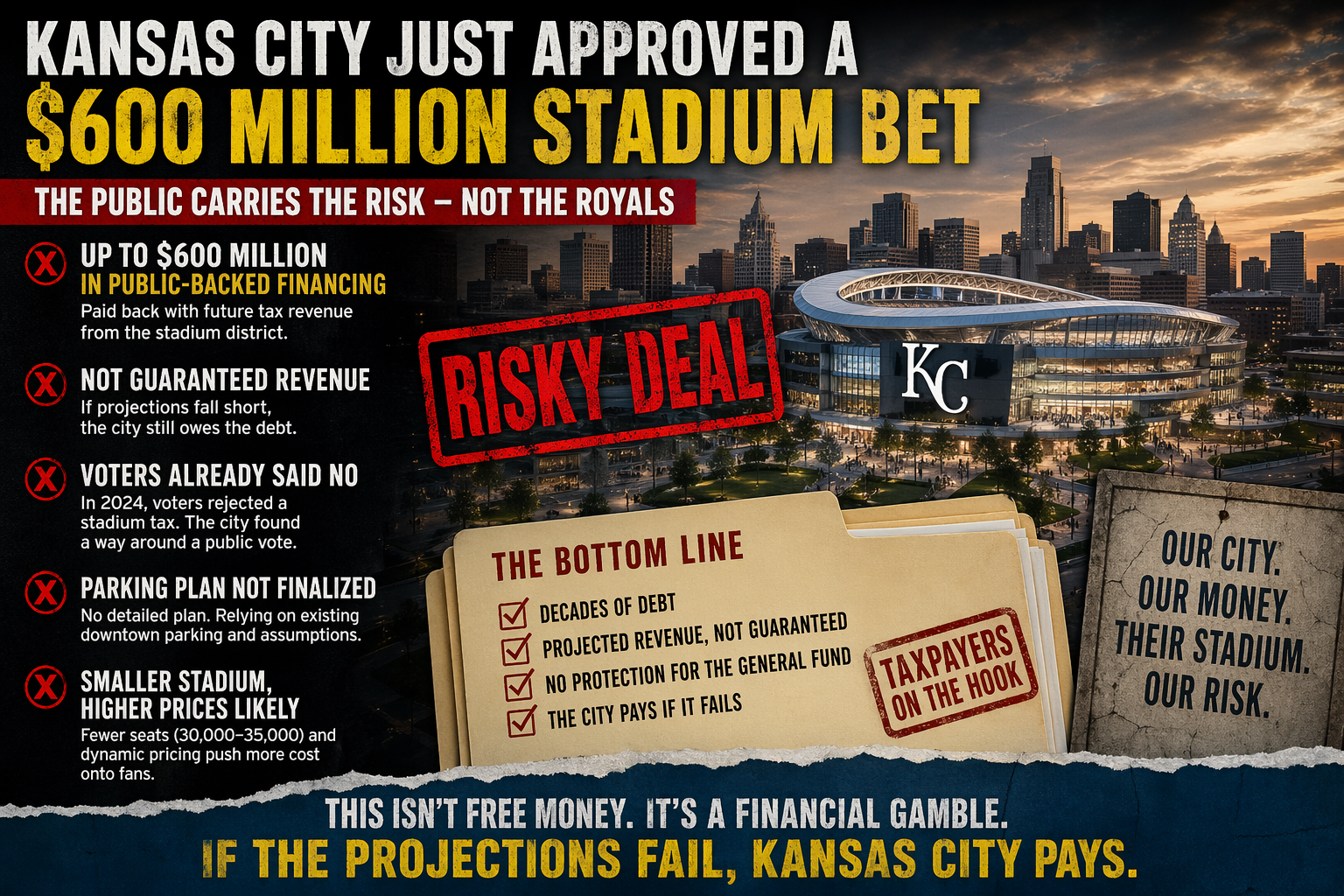
# Kansas City Just Approved a $600 Million Stadium Bet — And the Public Carries the Risk
Kansas City has approved a framework that could commit up to $600 million in public-backed financing for a new downtown Royals stadium.
The public message is that the project will “pay for itself.”
That statement is not guaranteed. It is a projection.
## This Is Debt Backed by the City
The city is not handing over $600 million upfront. It is preparing to issue bonds — long-term debt — to be repaid over decades using tax revenue generated from the stadium district.
Those projected revenues include:
- Sales taxes tied to activity at the site
- Earnings taxes from jobs connected to the development
- Additional economic activity attributed to the project
The key fact:
If those revenues do not meet projections, the debt still exists.
The city remains responsible for repayment.
That is the structure. There is no mechanism where the obligation disappears if the numbers fall short.
## The “Self-Funded” Claim Depends on Perfect Execution
City officials have emphasized that the project is not intended to impact the general fund.
That outcome only holds if revenue projections are met consistently over decades.
If they are not:
- The city must cover the gap
- That pressure moves into the broader budget
Kansas City is already operating under financial constraints, with rising costs and limited revenue growth. There is no built-in buffer for a major shortfall.
This is not risk removal. It is risk deferral.
## Voters Rejected Stadium Funding — The Structure Changed, Not the Outcome
In 2024, Jackson County voters rejected a stadium tax extension.
That result is clear.
The current plan avoids a public vote by using a different financing structure:
- City-controlled incentives
- Tax capture mechanisms tied to development
- Bond financing based on projected revenue
This approach is legally permitted.
The outcome is also clear:
A major publicly supported stadium plan moved forward without requiring voter approval after voters rejected a previous funding proposal.
## Port KC Is Not Detached From City Power
Port KC is formally an independent authority.
Operationally:
- Its board is appointed through city leadership
- It is routinely used to execute major development deals
- It works in alignment with City Hall on financing and implementation
That makes it part of the city’s development system, not an external check on it.
## Parking Remains Unresolved
There is no finalized, fully detailed public parking plan attached to this project.
Current positioning relies on:
- Existing downtown parking supply
- General estimates of nearby capacity
- Assumptions about shared use, transit, and walkability
What has not been publicly established:
- A finalized engineering plan for traffic and parking flow
- Verified modeling of demand versus capacity
- Dedicated infrastructure commitments typical of large stadium developments
This is a core operational component that remains undefined at a public level.
## Smaller Stadium, Revenue Optimization Model
The proposed stadium is expected to be:
- Approximately 30,000–35,000 seats
- Smaller than the current Kauffman Stadium
There is no official statement confirming higher ticket prices.
However:
- The team already uses dynamic pricing
- Modern stadium economics prioritize maximizing revenue per seat
The structure aligns with a model focused on higher yield per attendee rather than larger volume.
## The Entire Deal Is Projection-Dependent
Everything in this plan depends on projected future performance.
If projections hold:
- The financing structure functions as intended
If projections fall short:
- The debt obligation remains
- The city must absorb the financial impact
There is no safeguard that eliminates that exposure.
## The Bottom Line
This is a long-term financial commitment backed by the city.
It is dependent on:
- Sustained economic activity
- Accurate long-term projections
- Consistent tax generation over decades
Facts:
- Up to $600 million in public-backed financing
- Debt tied to projected, not guaranteed, revenue
- No absolute insulation from the general fund
- Smaller stadium footprint than the current facility
- No fully defined public parking and infrastructure plan
- A financing structure used that does not require voter approval after a prior rejection
This is not a guaranteed return project.
It is a structured financial bet.
If the projections hold, the model works.
If they do not, the obligation does not disappear.
The city still pays.