Kansas City 18th & Vine Spending Exposed: Decades of Failed Revivals While Downtown Parking Shrinks
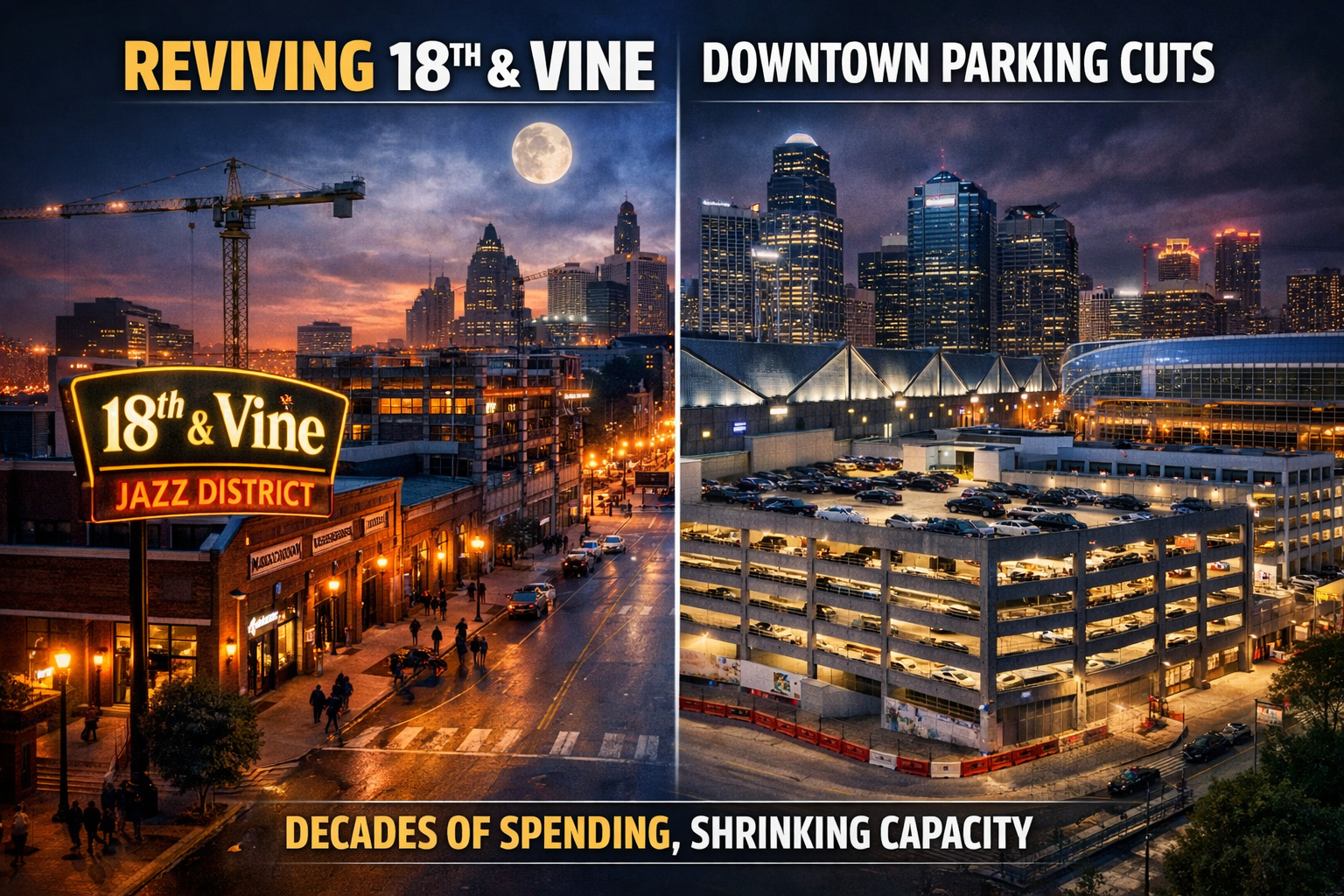
KANSAS CITY’S NEVER-ENDING “REVIVE THE VINE”: DECADES OF SPENDING, SHRINKING DOWNTOWN PARKING, AND STILL NO TRUE TRANSFORMATION
Kansas City is once again telling the public that 18th & Vine is being “revived.”
This time, the push is tied to the 2026 World Cup. The district is being labeled a “premier cultural destination,” positioned as a global showcase, and wrapped in international-event branding.
But this is not a new revival.
It is the latest version of a decades-long cycle.
Public records and reporting show that Kansas City has spent more than $100 million in public funds in the 18th & Vine district since 1990. Since then, there have been multiple structured redevelopment pushes: a 2016 Phase One investment, a 2021–2022 effort tied to a new Community Improvement District and public financing, and now the current “Revive the Vine” campaign, marketed as a $400+ million reinvestment effort combining public and private dollars.
Each phase came with the same promise: this time, it will work.
Yet the reality on the ground has not fundamentally changed.
WHAT IS ACTUALLY BEING BUILT RIGHT NOW
The current push includes an $8+ million pedestrian plaza, a $20 million parking garage, streetscape improvements, public art, and surrounding infrastructure work. These are real, documented expenditures, many of them timed to align with June 2026.
But none of these are major new attractions.
They are infrastructure.
They are support systems.
They are the type of projects that are supposed to serve a destination — not create one.
THE CORE PROBLEM: SAME ANCHORS, DIFFERENT MARKETING
Despite decades of investment, the district still relies on the same core attractions: the American Jazz Museum, the Negro Leagues Baseball Museum, and the Gem Theater.
These are historically significant.
They are culturally important.
But they are not new.
And more importantly, they are not enough on their own to drive sustained, large-scale demand.
Most of what is being added today falls into three categories: housing, renovations of existing buildings, or future concepts that are not yet operational.
That means the core issue remains unresolved.
Kansas City continues to invest in the surroundings while struggling to deliver new, high-demand anchors inside the district itself.
CRIME AND PERCEPTION STILL MATTER
Available neighborhood-level data shows that the 18th & Vine and Downtown East area continues to experience recurring issues involving assault, vandalism, and theft.
These are not isolated incidents.
They are patterns.
For a district being marketed to global visitors, perception matters as much as infrastructure.
And infrastructure alone does not fix perception.
DOWNTOWN PARKING: SHRINKING CAPACITY IN A GROWING CITY
While Kansas City is investing in new parking at 18th & Vine, downtown is moving in the opposite direction.
The redevelopment of Barney Allis Plaza replaces a garage originally designed for 975 spaces with a structure that will hold approximately 580 spaces.
City defenders argue that the old garage had deteriorated to the point where only a portion of those spaces were usable when it closed.
That may be true.
But that explanation avoids the real issue.
Downtown Kansas City is not shrinking.
It is expanding — more residents, more hotels, more events, and more demand.
And in the middle of that growth, the city is rebuilding a major parking asset on the same footprint while delivering significantly less total capacity than the original design allowed.
That is not a land constraint problem.
That is a planning decision.
If the structure is being rebuilt anyway, in the same location, in a growing downtown, the obvious question is:
Why not restore or exceed the original 975-space capacity?
There is no evidence that demand for downtown parking is disappearing.
Yet the outcome is a smaller garage, justified by the fact that the previous one was allowed to decline to the point where its full capacity no longer functioned.
That is not forward planning.
That is reacting to past neglect and locking in a lower ceiling for the future.
At the same time, the city continues to rely on broad claims about total downtown parking supply, rather than addressing whether parking is close, available, safe, and usable where demand actually exists.
Because total numbers do not solve real access problems.
The result is a contradiction:
Kansas City is adding parking in a district still trying to establish consistent demand, while reducing maximum potential capacity in the core of a growing downtown.
WORLD CUP OR DEADLINE PRESSURE
The timing of these projects is not subtle.
Multiple major components are scheduled for completion in June 2026, directly aligning with the World Cup.
That suggests the event is acting less as a justification and more as a deadline forcing projects forward.
The branding says global showcase.
The timeline says get it done before visitors arrive.
WHAT THE PUBLIC IS BEING ASKED TO BELIEVE
Kansas City is asking taxpayers to accept that this is a transformational moment, that this round of spending will succeed where previous efforts did not, and that infrastructure investments will unlock demand that has not materialized in past cycles.
None of those claims are proven.
All of them are promises.
THE REAL QUESTION
After more than three decades of public investment and multiple revival campaigns, the question is no longer whether 18th & Vine deserves investment.
The question is:
How many times can the same area be “revived” before the public starts asking whether the strategy itself is the problem?
Because at some point, it is no longer about funding.
It is about execution.
Kansas City’s pattern is clear:
Announce. Invest. Rebrand. Repeat.
Now it is happening again — this time with a global audience watching.
The difference in 2026 will not be the marketing.
It will be whether anything has actually changed.