Heather Sicks and the Kansas City Police Board: Is a Corporate Real-Estate Lawyer Qualified to Police KCPD?
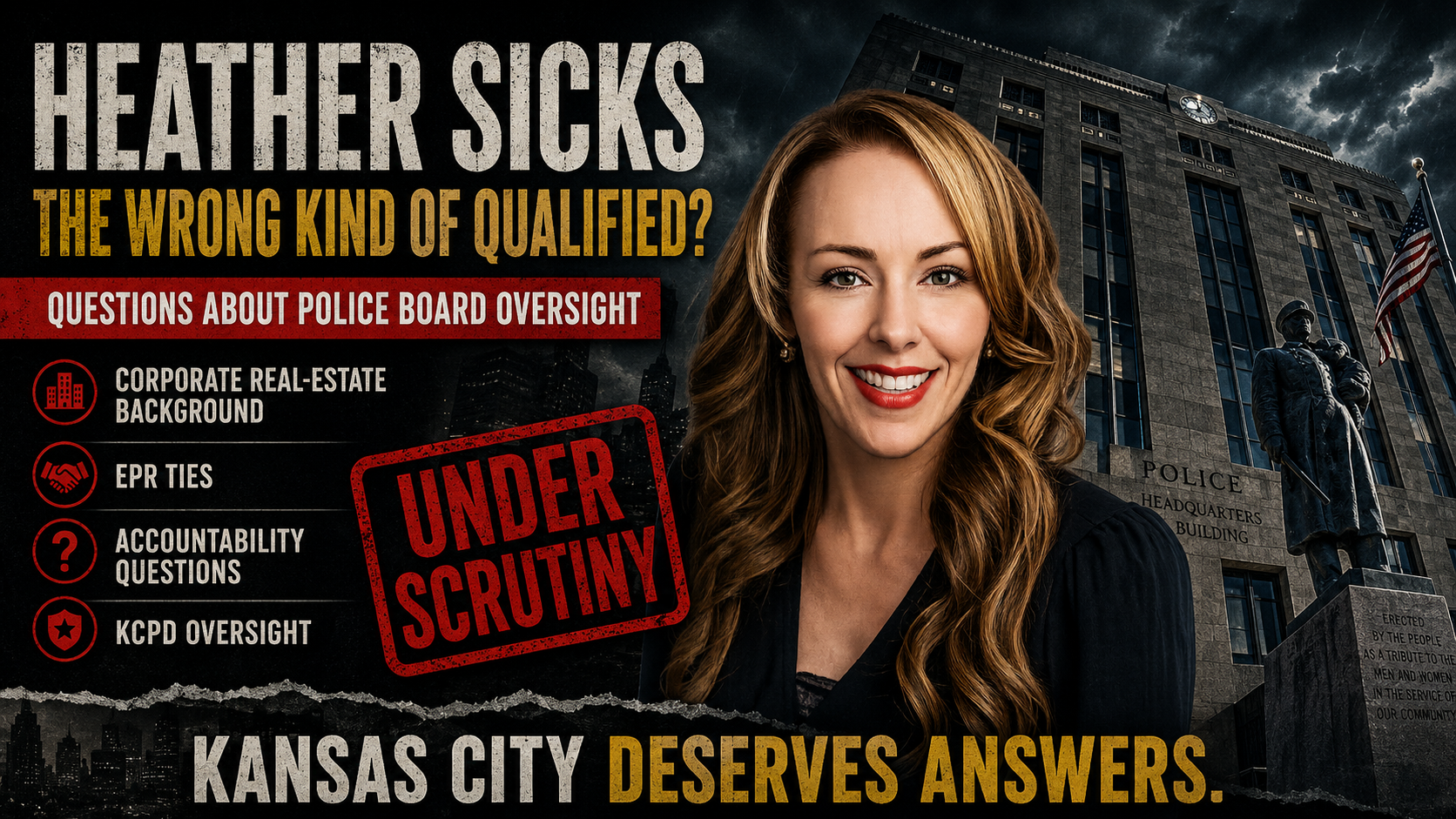
Heather Sicks Is the Wrong Kind of Qualified for Kansas City’s Police Board
Missouri did not put a proven police-accountability expert on the Kansas City Board of Police Commissioners.
It put a corporate real-estate lawyer there.
That is the uncomfortable truth behind Gov. Mike Kehoe’s appointment of Heather Sicks, the newest member of the board that helps control the Kansas City Missouri Police Department. On paper, Sicks has credentials. She is vice president and associate general counsel at EPR Properties. She has a law degree from UMKC. She has a criminal-justice degree from Missouri Southern State University. She has corporate legal experience, civic involvement, and a polished professional résumé.
But Kansas City residents should ask a harder question:
What part of that résumé proves she is prepared to govern one of the most controversial police departments in Missouri?
Because the Kansas City Board of Police Commissioners is not a ceremonial board. It is not a community-service trophy. It is not a networking appointment. Under Missouri law, the board determines police policy, appoints the chief of police, acts as a board of review in personnel disciplinary cases, and carries responsibility for preserving public peace, preventing crime, protecting rights, and enforcing laws in Kansas City.
That is real power.
So the issue is not whether Heather Sicks is educated. She is.
The issue is whether she is the right kind of qualified.
Based on the public record, the answer is not clear.
Sicks’s strongest documented professional experience is not police discipline, civil-rights oversight, use-of-force review, public corruption, constitutional policing, community violence prevention, or police labor accountability. Her strongest documented experience is corporate real estate.
EPR Properties describes Sicks’s job as leading legal matters tied to the acquisition, leasing, financing, and divestiture of experiential real-estate investments across entertainment, recreation, and attractions assets. That is a serious corporate-law role. It is not the same thing as police governance.
Kansas City deserves commissioners who understand the difference between supporting police and supervising police.
Those are not the same job.
The public record shows that Sicks was appointed by Gov. Mike Kehoe on April 27, 2026. The Missouri Senate Journal confirms that the Senate gave advice and consent on April 30, 2026. City records show she was scheduled to be sworn in as police commissioner on May 8, 2026.
That timeline matters because this appointment did not happen in a vacuum.
Kehoe’s previous pick, former Kansas City Councilwoman Heather Hall, collapsed after state Sen. Maggie Nurrenbern refused to sponsor Hall’s nomination. Nurrenbern raised concerns about Hall’s personal connections to the police department and whether she could be independent. Hall is married to a retired KCPD sergeant. Critics argued the police board needed public trust and independence, not another appointment viewed as too close to the department.
Then came Sicks.
Unlike Hall, Sicks lives in the district of Senate Majority Leader Tony Luetkemeyer, a Republican lawmaker known for his strong pro-law-enforcement record and his role in the state fight over Kansas City police funding. That made Sicks politically easier to move through the Senate.
That does not make her corrupt.
It does make the appointment look strategic.
Kehoe needed a nominee who could get confirmed after the Hall fight. Sicks appears to have solved that political problem. The bigger question is whether she solves Kansas City’s accountability problem.
That is where the appointment gets thin.
The public record does not show Sicks as a longtime police-reform advocate. It does not show her as a civil-rights attorney. It does not show a deep public record on officer discipline, use-of-force standards, racial disparities, police transparency, misconduct investigations, or the long-running fight over state control of KCPD.
In other words, the public can see that she is professionally accomplished.
The public cannot yet see why she is qualified to police the police.
That matters because Kansas City does not need passive police commissioners. Kansas City needs commissioners willing to ask uncomfortable questions, challenge the department when necessary, demand clean discipline, protect taxpayers from costly police misconduct, and explain major votes to the public.
KCPD has faced years of public controversy over accountability, officer discipline, use of force, lawsuits, settlements, and public trust. Even when crime drops, accountability does not become optional.
KCPD reported that homicides fell 5% in 2025 compared with 2024, non-fatal shootings fell 31%, robberies fell 27%, property damage fell 19%, stealing fell 15%, and stolen autos fell 32%. The department also reported a 75% homicide clearance rate. Those numbers are good news for Kansas City.
But falling crime numbers do not answer the police-board question.
A city can have lower crime and still have serious police-accountability problems.
That is exactly why the board matters.
The Blayne Newton case is a perfect example of why public trust is fragile. KCUR reported that Newton resigned from KCPD on February 13, 2026, received a $50,000 settlement, and is barred from future KCPD employment. KCUR also reported that Newton fatally shot three people and injured others during his nine-year KCPD career, and that KCPD settled a wrongful-death lawsuit connected to a 2023 shooting for $3.5 million.
That case should not be falsely framed as a pending matter still waiting to land on Sicks’s desk. It is not. Newton is gone.
But the Newton case is still a warning sign.
It shows how long accountability questions can drag on before the system reaches final action. It shows why the police board cannot be filled with people who simply “support law enforcement” in a generic political sense. The board needs people willing to ask whether the system is protecting the public, protecting taxpayers, or protecting the institution.
That is the test for Heather Sicks.
And there is another issue Kansas City should not ignore: EPR Properties.
EPR is not just Sicks’s employer. It is a Kansas City-based real-estate investment trust with major entertainment and attractions assets. In March 2026, EPR announced definitive agreements to acquire seven regional parks from Six Flags Entertainment Corporation in a $342 million transaction. The list included Worlds of Fun in Kansas City and Six Flags St. Louis.
That fact does not prove wrongdoing. It does not automatically prove a legal conflict.
But it absolutely raises fair public questions.
Sicks’s corporate role at EPR involves legal matters connected to acquisitions, leasing, financing, divestitures, entertainment, recreation, and attractions. EPR’s announced acquisition included Worlds of Fun, a major Kansas City attraction. KCPD and public-safety planning can affect large venues, traffic, event security, crowd control, public perception, and emergency response.
So Kansas City residents deserve clear answers:
Did Heather Sicks perform any legal work connected to the Worlds of Fun transaction?
Will she recuse from any police-board matter involving EPR Properties, Worlds of Fun, Six Flags, Enchanted Parks, off-duty officers, traffic control, public-safety deployments, or event-security coordination affecting EPR-linked properties?
Has she requested or received an ethics opinion?
Will that ethics guidance be made public?
Again, the issue is not an accusation. The issue is public confidence.
When a police commissioner’s private employer has major Kansas City entertainment assets, disclosure should be automatic. Recusal rules should be clear. The public should not have to guess.
That is especially true in a city where the police board itself is already controversial because Kansas City still does not have local control of its own police department. Four of the five police-board seats are appointed by the governor. The mayor sits as the fifth member. That structure has been challenged politically for years and is now part of broader public distrust.
The Sicks appointment does not fix that distrust.
It may deepen it if she does not act with immediate transparency.
Supporters will say Sicks has a criminal-justice degree. Fine. That is relevant. But a degree is not the same as a public record of police oversight. A degree does not prove independence. A degree does not prove toughness. A degree does not prove she will vote against the department when the facts require it.
Supporters will say she is a lawyer. Fine. But lawyers have specialties. A real-estate lawyer is not automatically qualified to oversee police discipline, civil-rights exposure, use-of-force cases, community complaints, and department policy.
Supporters will say she is successful. Fine. But success in corporate real estate is not the same thing as accountability in public safety.
Kansas City should stop confusing credentials with qualifications.
The police board needs more than polished résumés. It needs courage, independence, and public accountability.
Sicks can prove she belongs on the board. She can start by doing five things immediately:
First, she should publicly disclose any potential conflict involving EPR Properties, Worlds of Fun, Six Flags, Enchanted Parks, event security, off-duty police, traffic control, or police deployments affecting her employer’s assets.
Second, she should request a formal ethics opinion and release the conclusion publicly.
Third, she should publish a clear discipline philosophy explaining how she will review officer misconduct, repeat complaints, excessive-force findings, credibility problems, and cases where criminal charges are declined but public-trust concerns remain.
Fourth, she should commit to explaining major votes in plain English, especially votes involving discipline, litigation, budget priorities, and chief performance.
Fifth, she should prove that she understands the board’s role is not to protect KCPD from criticism, but to protect Kansas City from failure.
That is the standard.
Heather Sicks may be intelligent. She may be professional. She may be capable. Nothing in the verified record proves otherwise.
But the verified record also does not prove that she is the accountability commissioner Kansas City needs.
Right now, her public résumé shows a corporate real-estate attorney placed onto one of the most powerful police boards in Missouri after the governor’s previous nominee failed over independence concerns.
That is not enough.
Kansas City residents deserve more than a politically confirmable appointment. They deserve a police commissioner who can answer the hard questions before the next lawsuit, the next discipline scandal, the next excessive-force controversy, or the next taxpayer-funded settlement.
Heather Sicks now has the seat.
The public should demand proof that she has the backbone for the job.
Sources reviewed:
- Missouri Governor Mike Kehoe appointment release, April 27, 2026
- Missouri Senate Journal, April 27 and April 30, 2026
- Missouri Revised Statutes, Sections 84.350, 84.420, 84.430, and 84.500
- EPR Properties Heather Sicks leadership biography
- EPR Properties March 5, 2026 regional parks acquisition release
- Kansas City Clerk calendar showing Heather Sicks swearing-in
- KCPD January 5, 2026 crime statistics release
- KCUR reporting on Heather Hall withdrawal and Blayne Newton resignation
- KCTV5 reporting on Sen. Maggie Nurrenbern’s opposition to Heather Hall