Crispin Rea and the Kansas City Transparency Problem: Union Ties, Jail Shift, and Accountability Questions
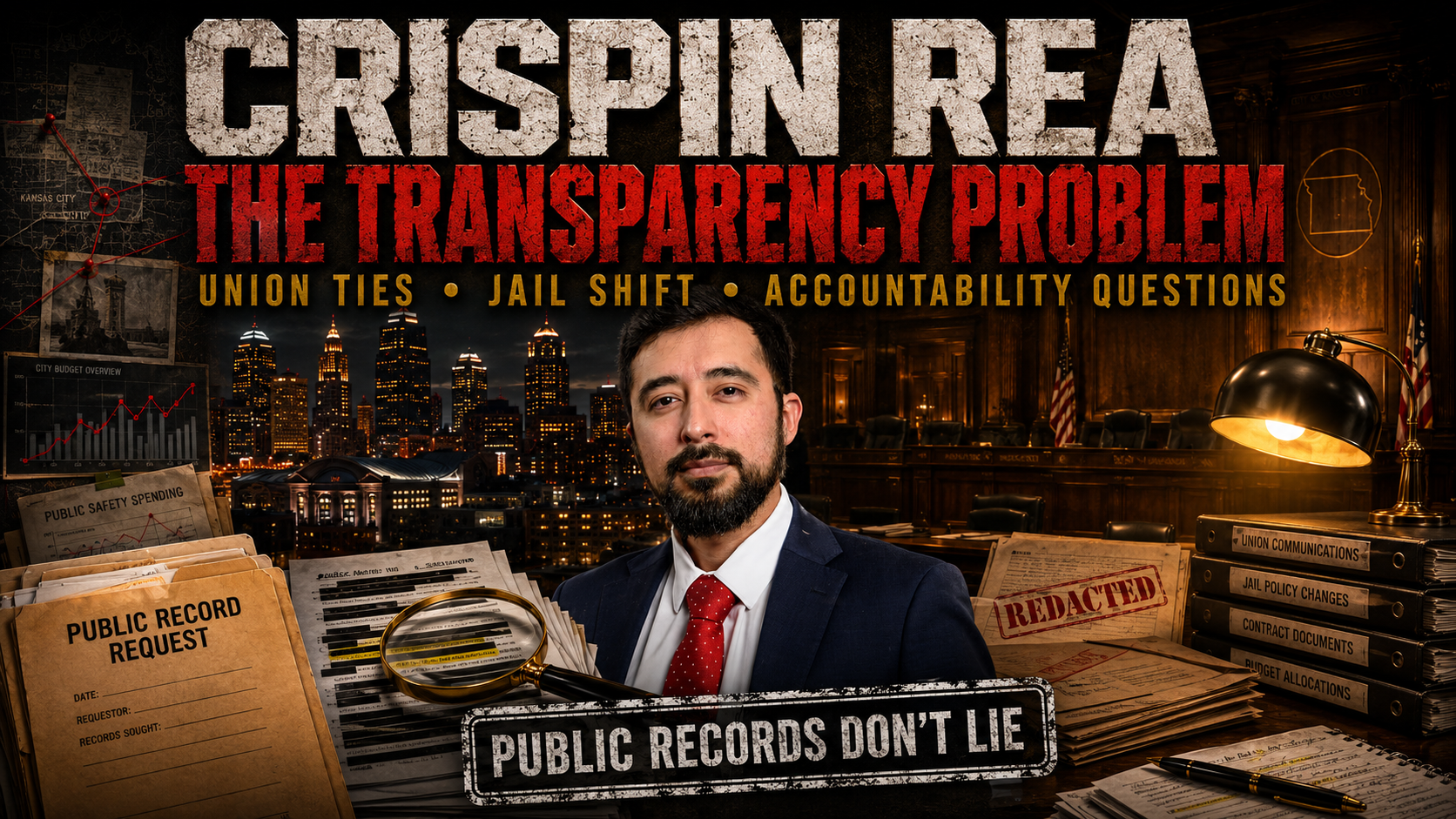
CRISPIN REA: The Councilman Who Sells You One Thing and Delivers Another
Kansas City's 4th District At-Large Councilman Crispin Rea has carefully constructed a political brand: a first-generation college graduate who grew up dodging gangs on the Eastside, a former prosecutor who protected women and children, a union man of the people. It's a compelling story. It's also one that doesn't hold up when you look at his actual record.
THE UNION CONFLICT NOBODY IS ASKING ABOUT
Councilman Crispin Rea publicly and proudly advertises on his official city biography that he is a "dues-paying union member of IAFF Local 42." Most Kansas Citians assume that means he has a sentimental connection to firefighters. What the official IAFF Local 42 website actually says is this: the union "represents 14 Bargaining Units within the metropolitan area made up of Fire Fighters, Paramedics, EMTs, and Prosecuting Attorneys." One of those listed bargaining units? Jackson County Prosecutors — Rea's employer for eight years before joining the council.
Rea sits on the city council's Finance, Governance, and Public Safety Committee — the body that controls public safety budgets and spending. He was also the council's most vocal champion of the quarter-cent public safety sales tax renewal — a 20-year commitment authorizing up to $250 million in public spending, including a new city jail and public safety infrastructure. That tax renewal was formally endorsed by IAFF Local 42.
In other words: Crispin Rea used his seat on the public safety committee to champion a massive spending measure that was directly backed by the union he pays dues to and has been a member of since his years as a Jackson County Prosecutor. He never disclosed the conflict. He never recused himself. He just voted.
Kansas City's Ethics Commission exists for exactly this reason. Whether Rea ever filed a required disclosure — and whether the Ethics Commission ever asked — is a question that deserves an answer. A Sunshine Law records request to the Kansas City Ethics Commission for any conflict of interest disclosures filed by Crispin Rea related to public safety budget votes and the 2025 sales tax renewal would settle the matter quickly.
THE JAIL HE SOLD YOU IS NOT THE JAIL YOU APPROVED
Rea spent the better part of two years positioning himself as the face of Kansas City's jail reform effort. He went to voter forums. He did the TV interviews. He assured constituents that the city would build a new $250 million detention center at a specific, voter-approved site at I-70 and 40 Highway.
Kansas City voters passed that plan in April 2025 — overwhelmingly. Then in January 2026, Mayor Quinton Lucas moved the jail to a completely different location near Front Street — next to a high school, next to established neighborhoods, and next to the city's tow lot. The ordinance wasn't even listed on the pre-published agenda. Council members waived the standard committee review and public testimony process. The vote happened the same day it was introduced.
Rea voted no and went on Facebook to complain. "With very little transparency, the Mayor pushed an ordinance to move the municipal detention center site from I-70 and 40 Hwy — a location overwhelmingly supported by voters last April — to Front Street," he wrote. "There was zero community engagement, we bypassed the ordinary council process of committee hearings and public testimony, and made the decision without completed analysis proving that it's a lower cost site."
He was right. And he lost anyway. The council passed it over his objections. Which raises a deeper question: after years of leading the jail effort, why did Rea have so little pull with his own colleagues when it counted? And more importantly — voters were sold one thing, paid for it with a 20-year sales tax, and got something else entirely. Crispin Rea was the public face of that sale.
THE "PROGRESSIVE" WITH A LOCK-THEM-UP RECORD
Rea likes to remind voters that he grew up on Kansas City's tough Eastside, as if that proximity to poverty inoculates him from policies that disproportionately hurt those same communities.
Look at his record. He proposed an ordinance to seize and destroy ATVs — not just vehicles caught in the act of illegal racing, but any vehicle deemed "not street legal" simply for being on the streets. He championed giving police authority to impound on sight, without any performance of actual illegal activity required. He looked to Connecticut — a state widely criticized for its aggressive sideshow enforcement — as a blueprint. Civil rights advocates and community organizations argued throughout the jail debate that building new carceral infrastructure and expanding police impoundment powers without due process disproportionately impacts Black and brown Kansas Citians. Rea has offered no serious response to those concerns.
For a man who spent eight years as a Special Victims Unit prosecutor, Rea's legislative instinct in nearly every situation appears to be the same: add more police power, add more incarceration, add more property seizure. That might make for a tough-on-crime campaign pitch. It's a harder sell as a reform agenda for the communities he claims to represent.
THE CHAMELEON CAREER
Before Crispin Rea was a progressive Democrat on city council, he was working inside Mayor Mark Funkhouser's office — widely regarded as one of the most embarrassing and divisive mayoral tenures in Kansas City's modern history. Reports at the time noted that Rea was rumored to be a young Republican before he reinvented himself for Funkhouser's campaign and administration.
He then ran for the KCPS school board and spent years there before attempting a run for the 3rd District At-Large council seat — a run he abandoned once Quinton Lucas, now the Mayor he publicly clashes with on the jail, entered the race. He spent years positioning himself before ultimately winning the 4th District At-Large seat in 2023.
That's not necessarily disqualifying. Politicians evolve. But when his official bio carefully omits the Funkhouser years, and when Ballotpedia noted that Rea didn't bother to complete their standard candidate survey before the 2023 election — the basic document that lets voters understand where you stand — it raises a fair question: what positions is Crispin Rea actually unwilling to put in writing?
THE HOMELESS SHELTER SHUFFLE
When a plan emerged to open a low-barrier homeless shelter in Kansas City's Northeast — backed by a nonprofit that had already been granted over $7 million in federal funds — Rea backed a do-over. He framed it as a fairness issue, saying the city should create multiple shelters across all parts of the city rather than concentrating services in one neighborhood.
The result? Hope Faith, the nonprofit awarded those federal dollars, was forced to reapply with no guarantee of selection. The city's executive director of Hope Faith was blunt about what that meant: "Every time that a solution to homelessness has come before our city, we've chosen to not do anything." Dressed up as regional equity, Rea's position delivered the same outcome Kansas City has delivered for decades — delay, process, and nothing for the people sleeping outside.
THE ACCOUNTABILITY DEFICIT
What ties all of this together is a pattern. Rea talks about transparency when it's politically convenient — like when he criticized Mayor Lucas for moving the jail without community input. But his own record includes pushing impoundment ordinances that bypass due process, championing a multi-decade tax tied to his own union without disclosing the conflict, delaying homeless shelter solutions under the cover of fairness, and refusing to answer a basic voter questionnaire before taking office.
Kansas City's 4th District residents — and every Kansas Citian now locked into a 20-year public safety sales tax — deserve a councilman who practices the transparency he preaches.
So far, Crispin Rea has been far better at talking about accountability than demonstrating it.